Tryphon of Vyatka is a saint of the Catholic Church (1546 - 1612). Tryphon of Vyatka's feast day is celebrated on 8 October. Tryphon of Vyatka is the patron saint of Vyatka;Vyatka land;Kirov.
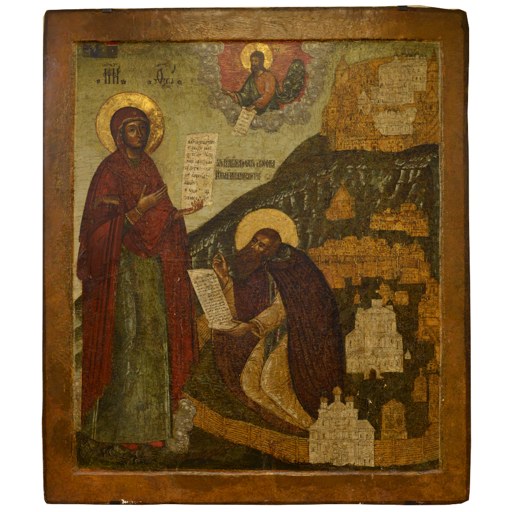
anonimus
License: Public domain
Tryphon of Vyatka
Saint- Life Span
- 1546 - 1612 (age 66)
- Feast Day
- 8 October
- Gender
- male
- Church
- Catholic
Places
Roles & Family
Patronage
Vyatka;Vyatka land;Kirov
Canonization
Biography
Saint Tryphon of Vyatka, known in the world as Trofim, was born in 1546 in the village of Malaya Nemnyuzhka in the Mezen volost of the Dvina district, a remote part of the Russian North in what is now Arkhangelsk Oblast. His parents were peasants of Orthodox faith. The traditional life of the saint describes him as a child drawn to church services, prayer, and fasting rather than to ordinary village occupations. When he reached marriageable age, his family intended that he should wed, but he left home without their consent in order to pursue a monastic vocation. For a time he lived as a wanderer and hired laborer in the Northern Dvina region, with stays associated with Orlets and Veliky Ustyug, before turning eastward toward the Kama River and the Perm lands.
In the Perm country Tryphon entered the Pyskor Monastery of the Transfiguration, an important house on the Kama linked to the regional saltworks, and there received the monastic tonsure. After a period of obedience and ascetic struggle he left the monastery to preach among the still largely pagan Ostyaks (Khanty) and Voguls (Mansi). According to his life, he destroyed a celebrated pagan shrine associated with a great birch tree, baptized converts, and attempted to plant a monastic community near the mouth of the Mulyanka River, in the district of what later became the city of Perm. Hostility from local inhabitants and from some Russian settlers who resented his interference with customary practices forced him to abandon that foundation and to seek another field of work.
About 1580 he came to Khlynov, the principal town of the Vyatka land. With the cooperation of the Vyatka clergy and with a charter of privileges obtained from the Muscovite court, he founded the Monastery of the Dormition of the Mother of God, which became known as the Trifonov Monastery and the chief monastic center of the region. Tryphon served as its first igumen (abbot). He journeyed to Moscow, where Tsar Feodor Ivanovich and Patriarch Job confirmed grants of land and legal rights for the monastery. He also established churches and lesser monastic sites in the Vyatka territory and continued missionary and pastoral work among Russians and among Finno-Ugric peoples of the area, including Votyaks (Udmurts). The monastery developed as a landholding institution typical of late Muscovite monasticism, and Tryphon had to defend its interests in a frontier town often marked by tension between townsmen, peasants, and monastic claims.
The closing decades of Tryphon’s life coincided with the dynastic crisis and the Time of Troubles. He experienced conflicts with Khlynov townsmen and periods of exile or absence from his own monastery, episodes recorded in the seventeenth-century vita as trials of patience. He died on 8 October 1612 and was buried in the Dormition church of the monastery he had founded. Reports of miracles and of the incorruption of his relics led to local veneration in the seventeenth century; he came to be honored throughout the Russian Orthodox Church as a monastic founder and wonderworker and as the heavenly patron of the Vyatka land. His principal feast is 8 October. The Holy Dormition Trifonov Monastery in present-day Kirov remains associated with his memory, though like many Russian houses it suffered suppression and later restoration.