Turibius is a saint of the Catholic Church (1538 - 1606). Turibius's feast day is celebrated on 23 March. Turibius is the patron saint of Peru;Latin American bishops.
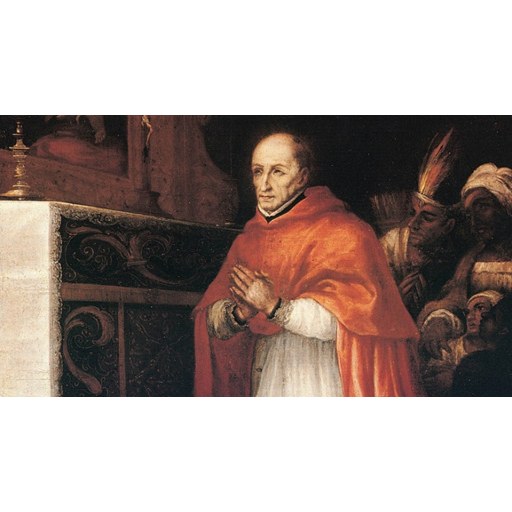
https://www.franciscanmedia.org/saint-of-the-day/saint-turibius-of-mogrovejo
License: unknown
Turibius
Saint- Life Span
- 1538 - 1606 (age 68)
- Feast Day
- 23 March
- Gender
- male
- Church
- Catholic
Places
Roles & Family
Patronage
Peru;Latin American bishops
Canonization
Biography
Turibius Alphonsus de Mogrovejo (Spanish: Toribio Alfonso de Mogrovejo) was born in 1538 at Mayorga de Campos in the Kingdom of León, in Spain, into a family of the local nobility. He received a legal education at the universities of Valladolid, Salamanca, and Coimbra and later taught canon law at Salamanca. While still a layman he was appointed by King Philip II to judicial office in the tribunal of the Inquisition at Granada, which he held during the 1570s. In 1578 or 1579 the king nominated him Archbishop of Lima, then a vast metropolitan see covering much of Spanish South America. Because he was not yet a cleric, he was ordained priest and consecrated bishop in Spain in 1580 before sailing for Peru. He reached Lima in 1581 and took possession of the see. He was never a member of a religious order and remained a secular priest and bishop for the rest of his life.
His episcopate applied the reform program of the Council of Trent to a colonial church still taking shape. He held diocesan synods and three provincial councils. The Third Council of Lima (1582–1583) issued a catechism and pastoral directories in Spanish, Quechua, and Aymara and set lasting norms for clergy and for ministry among indigenous peoples. In 1591 he founded a conciliar seminary in Lima, generally identified as the first seminary of Tridentine type in the Americas. Over more than two decades he made repeated visitations of a territory stretching along the Pacific coast and into the Andes, often traveling on foot or by mule, and he learned enough Quechua and Aymara to preach and to examine candidates for ministry. He confirmed very large numbers of people; among them was Isabel Flores de Oliva, later Saint Rose of Lima.
Turibius repeatedly opposed the exploitation of indigenous communities by encomenderos and by some colonial officials, and he disciplined clergy who were absent from their posts, poorly trained, or abusive. Those stands brought him into conflict with viceregal authorities and with portions of both the secular and the regular clergy. He insisted on pastoral residence, on the use of native languages in catechesis, and on the administration of the sacraments without simony. Contemporary and later Catholic accounts present him as a reforming metropolitan of the post-Tridentine Church rather than as a missionary of a religious order.
In early 1606, while on visitation in the northern part of his diocese, he fell ill and died on 23 March at Saña (Zaña) in present-day Peru. His remains were later translated to the cathedral of Lima. He was beatified by Pope Innocent XI in 1679 and canonized by Pope Benedict XIII in 1726. The General Roman Calendar keeps his feast on 23 March. He is venerated as a patron of Peru and, by declaration of Pope John Paul II in 1983, as patron of the bishops of Latin America.