Twenty-six Martyrs of Japan is a saint of the Catholic Church (d. 1597). Twenty-six Martyrs of Japan's feast day is celebrated on 6 February. Twenty-six Martyrs of Japan is the patron saint of Japan.
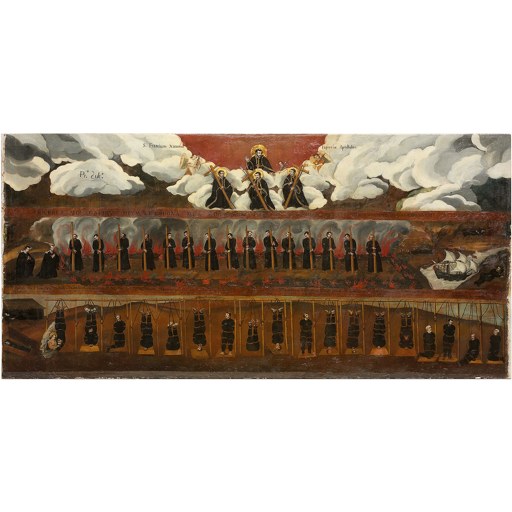
Anonymous Japanese Master (painter)
License: Public domain
Twenty-six Martyrs of Japan
Saint- Life Span
- d. 1597
- Feast Day
- 6 February
- Gender
- male
- Church
- Catholic
Places
Sacred Place

Roles & Family
Patronage
Japan
Canonization
Biography
The Twenty-six Martyrs of Japan were Catholics crucified at Nagasaki on 5 February 1597. They were the first Christians in Japan to be executed as a group after the faith had been planted there in the mid-sixteenth century, and they became the first saints of Japan in the Catholic Church. Jesuit missionaries under Francis Xavier had reached Kagoshima in 1549. In the following decades the mission, later joined by Spanish Franciscans from the Philippines, won a large following, especially in western Japan. Estimates for the later sixteenth century commonly speak of some two hundred thousand Japanese Christians. Toyotomi Hideyoshi, who was completing the political unification of the country, issued an edict in 1587 that ordered foreign missionaries to leave and forbade the practice of Christianity, but the ban was applied unevenly and missionary work continued for nearly a decade.
The crisis that produced the twenty-six deaths is tied to the wreck of the Spanish galleon San Felipe on the Japanese coast in 1596 and to Hideyoshi’s distrust of the Franciscans who had been living and preaching openly in Kyoto and Osaka. Reports that a Spanish officer had described missionaries as preparing the way for conquest, together with the visibility of the friars, led Hideyoshi to order arrests. Twenty-six Catholics were taken in the capital region: six Franciscan friars of the Order of Friars Minor, among them the Spanish superior Pedro Bautista, Felipe de Jesús (born in Mexico City), and Gonsalo Garcia (born at Bassein in Portuguese India); three Japanese Jesuits, Paulo Miki, John Soan de Goto, and James Kisai; and seventeen Japanese laymen, of whom three were boys of about twelve to fourteen years of age. Several of the laity belonged to the Franciscan Third Order. The prisoners had their ears mutilated and were then forced to walk in winter from Kyoto to Nagasaki, a journey of several weeks and many hundreds of miles, during which they were displayed in the towns as a public warning.
On 5 February 1597 they were led to Nishizaka Hill, overlooking the harbor of Nagasaki, and bound to crosses. Soldiers completed the execution by driving spears into their sides. Contemporary accounts, especially Jesuit reports, record that Paulo Miki preached to the onlookers from his cross, professing that he died a Christian and a Japanese, not a traitor, and that he forgave the authorities and the executioners. The bodies were left on the crosses; Christians later recovered relics, which were carried to Macau and to churches in Europe and the Americas. The executions did not halt the spread of Christianity at once, but they marked a turning point. After Hideyoshi’s death the Tokugawa shogunate issued a nationwide ban in 1614, expelled missionaries, and over the following decades put thousands of Japanese Christians to death. Public Christianity was extinguished; communities that survived did so in secret as Kakure Kirishitan until missionaries encountered them again in the 1860s.
Pope Urban VIII beatified the twenty-six in 1627. Pope Pius IX canonized them on 8 June 1862. Their liturgical memorial is observed on 6 February in the General Roman Calendar. In Nagasaki the site of the crucifixion is commemorated by the Twenty-Six Martyrs Monument and a museum at Nishizaka. They are venerated as the principal martyrs of Japan and as patrons of the Catholic Church in that country. Later Japanese martyrs of the seventeenth century, including those of the Great Genna Martyrdom of 1622 and many others beatified or canonized in the twentieth and twenty-first centuries, are often associated with them in Japanese Catholic memory, but the group of 1597 remains the first and most widely known.