Ubaldesca Taccini is a saint of the Catholic Church (1136 - 1206). Ubaldesca Taccini's feast day is celebrated on 28 May. Ubaldesca Taccini is the patron saint of Calcinaia.
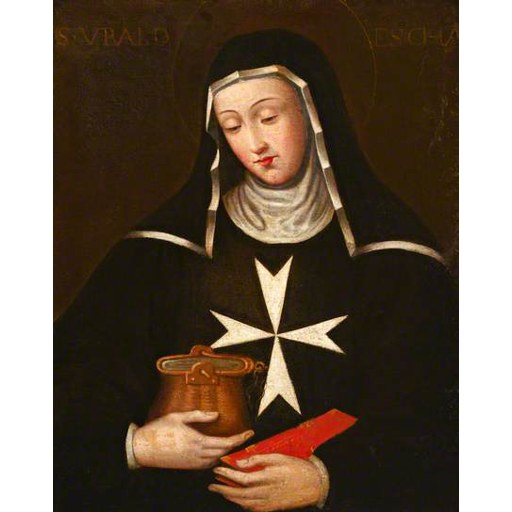
Unknown authorUnknown author
License: Public domain
Ubaldesca Taccini
Saint- Life Span
- 1136 - 1206 (age 70)
- Feast Day
- 28 May
- Gender
- female
- Church
- Catholic
Places
Roles & Family
Religious Information
Patronage
Calcinaia
Biography
Ubaldesca Taccini was born in 1136 in Calcinaia, a small agricultural community in the Arno valley of Tuscany, then within the orbit of the maritime republic of Pisa. Traditional accounts describe her family as poor peasants of sincere Christian practice. From childhood she was remembered for unusual piety, fasting, and a readiness to give away what little she had. Around the age of fifteen she associated herself with the Order of Saint John of Jerusalem, the Knights Hospitaller, whose white eight-pointed cross she thereafter wore. The order, founded to care for sick pilgrims in the Holy Land, maintained hospitals and churches in Italian port cities; Pisa was one of its important western houses. Ubaldesca left Calcinaia for Pisa and entered a life of consecrated service rather than marriage, remaining a sister of the Hospitallers for the rest of her days.
In Pisa she was attached to the church and hospital of San Giovanni, where for some fifty-five years she performed humble work among the sick, pilgrims, and urban poor. Twelfth-century Hospitaller houses combined liturgical life with practical charity, and the sources present her not as an administrator or foundress but as a lay sister occupied with nursing, fetching water, baking, and distributing alms. Her reputation for holiness grew among the Pisan populace and among members of the order. Hagiographical tradition, of a kind typical of central Italian local sanctity in this period, credits her with miracles of provision: water she carried in a pitcher is said to have turned into wine, recalling the wedding at Cana; bread given to the hungry is said to have multiplied; and a well at Calcinaia became associated with her intercession. These stories cannot be verified as historical events, but they were already circulating in the generations after her death and formed the core of her legend.
She died in Pisa on 28 May 1206 and was buried in the church of San Giovanni. Veneration began at once, as was common for locally recognized holy women in communal Italy before the later centralization of canonization at Rome. No reliable source records a formal papal canonization or beatification of the post-medieval type; her cult rested on popular acclaim and ordinary episcopal tolerance. Her feast is kept on 28 May. She is the patron saint of Calcinaia, which has continued to honor her with processions, a parish dedication, and, in the modern period, the translation of relics from Pisa. The Sovereign Military Order of Malta, successor of the medieval Hospitallers, still commemorates her among the saints of the order.
What can be said with confidence is therefore limited but consistent: a Tuscan woman of peasant origin, born in the second quarter of the twelfth century, lived a long life of Hospitaller charity in Pisa, died there in 1206, and became the focus of a durable local and order-based cult. Later embellishments of vision, prophecy, and miracle belong to the hagiographical tradition rather than to independently documented biography. Even so, her figure remains one of the clearer examples of female Hospitaller sanctity in medieval Italy, linking a rural Arno-valley birthplace with the urban hospital culture of Pisa and with the international military-religious order that claimed her as its own.