Ulderic is a saint of the Catholic Church (890 - 973). Ulderic's feast day is celebrated on 4 July. Ulderic is the patron saint of Augsburg;Diocese of Augsburg;pregnant women;women in childbirth;weavers;against fever;against mice;against moles;against faintness;happy death.
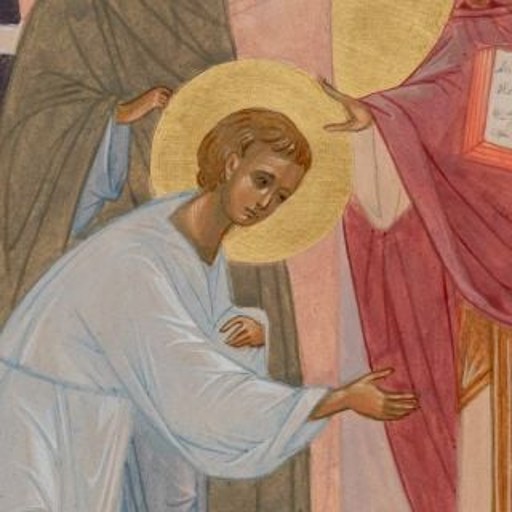
https://catalog.obitel-minsk.com/icons-prav/painted-icons.html
License: unknown
Ulderic
Saint- Life Span
- 890 - 973 (age 83)
- Feast Day
- 4 July
- Gender
- male
- Church
- Catholic
Places
Roles & Family
Patronage
Augsburg;Diocese of Augsburg;pregnant women;women in childbirth;weavers;against fever;against mice;against moles;against faintness;happy death
Canonization
Biography
Saint Ulderic, known in Latin as Udalricus and in German as Ulrich of Augsburg, was a tenth-century bishop whose career unfolded in the East Frankish kingdom during the reigns of Henry I and Otto I. Traditional accounts place his birth in 890 at Kyburg in what is now the canton of Zurich, Switzerland, then within the Duchy of Swabia. He was the son of Count Hucpald of Dillingen and of Dietbirg, a woman of Swabian noble lineage. Frail in childhood, he was entrusted to the monks of the Abbey of Saint Gall, one of the foremost centers of learning in the German lands, where he studied letters, liturgy, and scripture. After leaving Saint Gall he joined the household of his uncle Adalbero, bishop of Augsburg, received holy orders, and accompanied the bishop on a pilgrimage to Rome. Following Adalbero’s death in 909 he lived for a time in relative seclusion, occupying himself with prayer and study, until King Henry I nominated him to the vacant see of Augsburg in 923.
As bishop, Ulderic inherited a diocese damaged by Magyar incursions and by the political instability of the early tenth century. He set about rebuilding churches and restoring ecclesiastical discipline, visiting the parishes of his large territory, and providing for the education of clergy. He lived with notable personal austerity, abstaining from meat, sleeping on a hard bed, and personally serving the poor, especially on Maundy Thursday when he was accustomed to wash the feet of the needy and to wait upon them at table. He fostered the cult of the martyr Saint Afra, whose shrine lay in Augsburg, and he worked to strengthen the city’s fortifications. His most celebrated public role came in 955, when Magyar forces again invaded Bavaria and laid siege to Augsburg. Ulderic organized the defense of the city, celebrated Mass and encouraged the garrison, and after King Otto I’s victory over the Magyars at the Battle of the Lechfeld on 10 August 955 he was widely regarded as having contributed both spiritually and practically to the salvation of the German lands from further nomadic raids.
In old age Ulderic wished to resign his bishopric in favor of a nephew, also named Adalbero, but a synod refused to permit what appeared to be an attempt to treat the see as a family possession. He therefore remained bishop until the end of his life. He died at Augsburg on 4 July 973 and was buried in the church of Saint Afra. A contemporary vita composed by Gerhard, a priest of Augsburg who had known him, preserved the memory of his pastoral labors and of miracles attributed to him in life and after death. Popular veneration grew quickly. On 31 January 993 Pope John XV, presiding over a synod in the Lateran basilica at Rome, formally inscribed Ulderic in the catalogue of saints. This act is generally regarded by historians as the first papal canonization in the later medieval sense, that is, a central Roman declaration rather than a purely local episcopal or popular recognition. His feast day is 4 July.
Ulderic is venerated as principal patron of the city and diocese of Augsburg. Over the centuries the faithful have also invoked him as patron of pregnant women and of those in childbirth, of weavers, and as a protector against fever, against mice and moles, against dizziness or faintness, and for the grace of a happy death. The Benedictine abbey church of Saints Ulrich and Afra in Augsburg became the center of his cult, and his relics have been honored there through the later Middle Ages and into modern times. Although some details of his early life rest on later tradition, the outline of his episcopate, his part in the events of 955, and the circumstances of his canonization in 993 rest on contemporary or near-contemporary testimony and on the official acts of the Roman synod.