Urban of Langres is a saint of the Catholic Church (d. 390). Urban of Langres's feast day is celebrated on 2 April. Urban of Langres is the patron saint of vine-growers;vine-dressers;vintners;coopers;gardeners;vineyards;against blight;against frost;against storms;against alcoholism;against faintness.
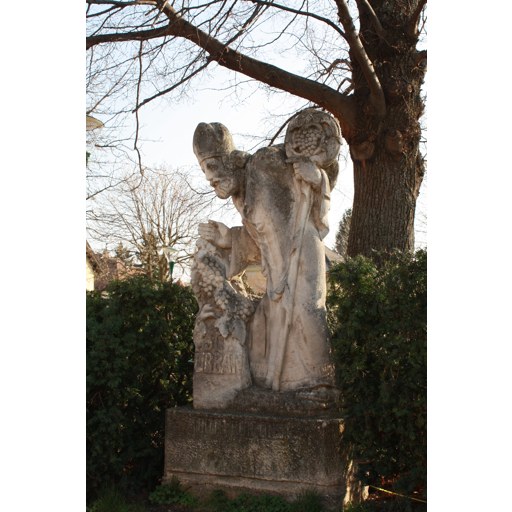
Karl Gruber
License: CC BY 3.0
Urban of Langres
Saint- Life Span
- d. 390
- Feast Day
- 2 April
- Gender
- male
- Church
- Catholic
Places
Roles & Family
Patronage
vine-growers;vine-dressers;vintners;coopers;gardeners;vineyards;against blight;against frost;against storms;against alcoholism;against faintness
Biography
Urban of Langres (Latin Urbanus Lingonensis) was a fourth-century bishop of Langres, the ancient city of the Lingones in Roman Gaul, in what is now the department of Haute-Marne in northeastern France. Later medieval catalogues of the see count him as its sixth bishop and place his episcopate from about 374 until a death traditionally assigned to around 390. He is said in those same lists to have succeeded Saint Desiderius (Didier). Almost nothing about his family, education, or life before the episcopate can be established from contemporary evidence. Later hagiography asserts that he was a native of Langres and that he had a sister named Leodegaria (Léodegarie), locally honored as a saint, but these claims are not corroborated by fourth-century sources, and no year of birth is recorded.
The documentary record for the church of Langres in the later fourth century is extremely thin. By the time Urban is supposed to have become bishop, Christianity had been legally tolerated in the empire for decades, and it was advancing toward official status under the later Constantinian and Theodosian settlement. Rural Gaul, however, still retained strong pagan custom, and the organization of dioceses, clergy, and liturgy was unfinished work. Later legend recounts that Urban took refuge in a vineyard during a persecution, converted the vine-dressers who sheltered him, and thereafter used those workers as helpers in evangelization. Historians treat the episode as pious folklore rather than a datable event. It may have been shaped to explain his later patronage of viticulture, or it may conflate memories of earlier, pre-Constantinian troubles with his own lifetime. The chronology of the Langres episcopal list itself is not above suspicion, since other traditions place a martyr-bishop Desiderius of Langres in a later generation; the figures 374 and 390 should therefore be read as conventional catalogue dates, not as independently verified facts.
From the Middle Ages onward Urban was invoked as a protector of vineyards and of everyone whose livelihood depended on the grape. He became patron of vine-growers, vine-dressers, gardeners, vintners, and coopers, and was called upon against blight, frost, storms, faintness, and the dangers of drunkenness. The cult flourished in wine-growing country in France and across the Rhineland and other German-speaking regions. In those same lands the name Urban was also attached to Pope Urban I (third century), whose feast on 25 May falls near a meteorologically sensitive point in the vine-grower’s year; popular devotion often blended or confused the two saints. The Roman Martyrology commemorates Urban, bishop of Langres, on 2 April; some local calendars have kept 2 July or other days.
Urban was never the subject of a formal papal canonization of the later medieval or modern type. His cult belongs to the ancient, pre-congregational veneration of holy bishops. He is honored in the Roman Catholic Church and is also listed among saints commemorated in Eastern Orthodox tradition. The place of his burial is not securely recorded in surviving sources. Because so little can be verified from fourth-century evidence, Urban of Langres remains a historically attested Gallic bishop around whom a rich but largely legendary patronal cult of wine, weather, and the countryside later grew. Distinction between this Urban and Pope Urban I is essential for any accurate account of either cult.