Urban of Macedonia is a saint of the Pre-Schism (Universal) Church. Urban of Macedonia's feast day is celebrated on 31 October.
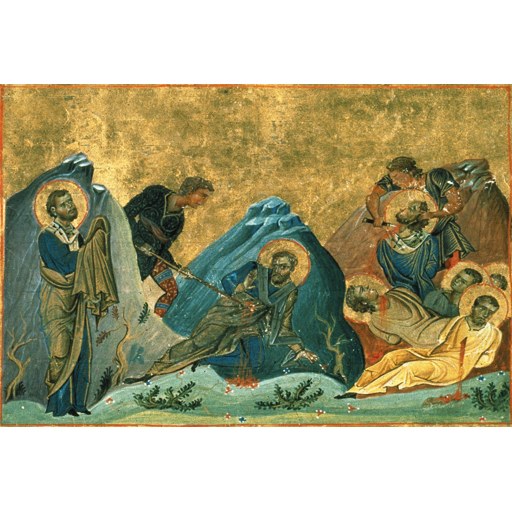
Authors of Menologion of Basil II (circa 985 AC, Constantinople), Byzantine manuscript illuminators[1]: Pantoleon with Georgios, Michael the Younger, Michael of Blachernae, Symeon, Symeon of Blachernae, Menas, and Nestor (Online on Vatican site)
License: Public domain
Urban of Macedonia
Saint- Feast Day
- 31 October
- Gender
- male
- Church
- Pre-Schism (Universal)
Roles & Family
Biography
Urban of Macedonia, also known in Latin as Urbanus, is numbered among the Seventy Apostles (Seventy Disciples) in Eastern Christian hagiographical tradition. He is commonly identified with the Urbanus whom the Apostle Paul greets in the Epistle to the Romans: “Greet Urbanus, our fellow worker in Christ” (Romans 16:9). That New Testament notice is the only contemporary literary reference that can be tied to him with any confidence; it places a Christian named Urbanus among Paul’s co-workers and among persons known to the Roman church in the mid-first century. Later tradition, rather than independent first-century documentation, supplies the rest of his story.
According to Orthodox synaxaria and related notices on the Seventy, Urban was a companion and helper of the Apostle Andrew the First-Called. Andrew is said to have ordained him bishop in Macedonia, and the epithet “of Macedonia” reflects that episcopal assignment rather than a verified birthplace. In that role he is believed to have preached and to have helped organize Christian communities in the Roman province of Macedonia during the apostolic age. He is grouped in the liturgical sources with other members of the Seventy associated with Andrew, notably Stachys, Amplias, Narcissus, Apelles, and Aristobulus.
Tradition further holds that Urban died a martyr, but the circumstances, place, and date of his death are not recorded in surviving historical sources. No birth year, birthplace, burial site, or detailed contemporary biography is known. As with many of the Seventy, his cult rests on brief menologion entries and shared commemorations rather than on a full vita. In the Eastern Orthodox calendar he is remembered on 31 October together with those companions, and also on 4 January at the Synaxis of the Seventy Apostles.
Urban was not Bishop of Rome and did not hold a patriarchal see. He belongs to the apostolic period, before later formal processes of beatification or canonization; veneration of him arose through ancient liturgical custom. Distinguishing him from later figures who bore the name Urban, including third-century Pope Urban I, is essential. Beyond the Pauline greeting, the Andrew tradition, the Macedonian episcopate, and the martyr’s commemoration, reliable historical detail is lacking, and the identification of Romans 16:9 with the bishop-martyr of Macedonia remains traditional rather than independently demonstrable.