Ursicinus of Saint-Ursanne is a saint of the Catholic Church. Ursicinus of Saint-Ursanne's feast day is celebrated on 20 December. Ursicinus of Saint-Ursanne is the patron saint of Saint-Ursanne.
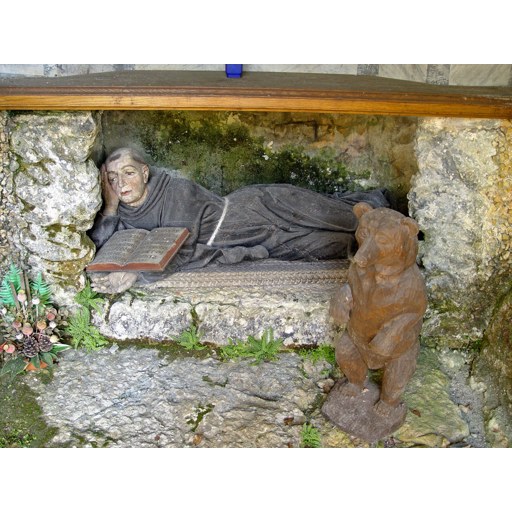
Yesuitus2001
License: CC BY-SA 2.5
Ursicinus of Saint-Ursanne
Saint- Feast Day
- 20 December
- Gender
- male
- Church
- Catholic
Places
Roles & Family
Religious Information
Patronage
Saint-Ursanne
Biography
Ursicinus of Saint-Ursanne, known in French as Saint Ursanne, was a seventh-century monk and hermit whose memory is preserved chiefly by later medieval hagiography and by the local cult of the town that bears his name. Contemporary seventh-century sources do not give a connected biography of him, and the year of his birth is unknown. Tradition, which is consistent across later accounts, makes him an Irishman who entered the monastic family of Saint Columbanus at Luxeuil in the Vosges, in the Frankish kingdom. Luxeuil, founded by Columbanus near the end of the sixth century, was one of the principal houses of Irish monasticism on the Continent. Its monks followed the austere Rule of Columbanus and were sent out as missionaries and founders across Burgundy, Austrasia, and the Alpine forelands. Ursicinus is numbered among those disciples.
Around 610 Columbanus was driven from Luxeuil by the Burgundian court. Several of his monks went with him into exile. According to the traditional narrative, Ursicinus accompanied his master for a time—accounts vary as to whether he went as far as the Rhine or toward Italy—and then left the travelling party in order to live as a hermit. He settled in a cave or rocky shelter in the deeply incised valley of the river Doubs, in the Jura mountains, at the site of the later town of Saint-Ursanne in what is now the Swiss Canton of Jura. That region then lay within the Frankish realms, in a still thinly Christianized upland country. The choice of a remote Doubs gorge fits the Irish eremitical ideal that Columbanus himself had practised and taught: severe fasting, solitude, and prayer, combined with eventual pastoral contact with neighbouring people.
Later tradition holds that Ursicinus preached among the inhabitants of the surrounding valleys and that a small group of disciples gathered about his hermitage. He is not recorded as a bishop, nor as holding any patriarchal or Roman see; his role is that of priest-hermit and, in some martyrological wording, abbot of the little community that formed around him. His death is placed by later writers around 620 or 625; the exact year cannot be verified. He was buried at the hermitage. From the tomb a monastery developed. In the high Middle Ages the house was reorganised as a chapter of secular canons. The collegiate church of Saint-Ursanne, with Romanesque fabric and later Gothic work, still stands in the small walled town that took the saint’s name, and his relics have been venerated there. A sculpted tomb associated with him remains among the church’s furnishings. Local memory also points to a cave in the Doubs gorge as the place of his eremitical life.
The cult of Ursicinus was always regional, centred on the Doubs valley and on the historical diocese of Basel, to which the district belonged. His feast is kept on 20 December. He is the patron saint of the town of Saint-Ursanne. The Latin name Ursicinus (from ursus, “bear”) underlies the French form Ursanne that passed to the settlement. His life belongs to the wider seventh-century pattern of Columbanian hermitages and priories in the Jura—comparable in type, though not in surviving documentation, to other local foundations of that missionary generation. Because almost no contemporary written evidence survives, the precise facts of his birth, the stages of his journey from Luxeuil, and the exact date of his death remain uncertain; the outline given here follows the stable later hagiographical and local historical tradition that identifies him as an Irish companion of Columbanus and as the founding hermit of Saint-Ursanne.