Ursula Micaela Morata is a venerable of the Catholic Church (1628 - 1703). Ursula Micaela Morata's feast day is celebrated on 9 January.
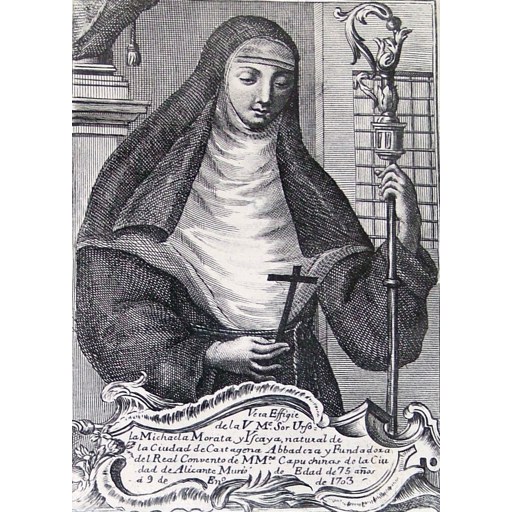
Unknown authorUnknown author
License: Public domain
Ursula Micaela Morata
Venerable- Life Span
- 1628 - 1703 (age 75)
- Feast Day
- 9 January
- Gender
- female
- Church
- Catholic
Places
Roles & Family
Religious Information
Biography
Úrsula Micaela Morata was born on 21 October 1628 in Cartagena, in the Kingdom of Murcia in Spain, the daughter of Marcos Morata, a soldier, and Juana Morell. She was baptized shortly afterward in the parish church of Santa María de Gracia. Left fatherless in early childhood and orphaned of her mother while still a young girl, she was raised by relatives. From a very early age she was reported to have experienced visions and other mystical phenomena, including an apparition of the Child Jesus when she was about four years old. These experiences, together with a marked attraction to prayer and penance, oriented her toward enclosed religious life in seventeenth-century Catholic Spain, a setting in which female mysticism and the reformed Franciscan orders were prominent.
In 1645 she entered the monastery of the Capuchin Poor Clares of San José in Murcia, received the religious habit, and later made her profession as a Capuchin Poor Clare. She thereby embraced enclosure, poverty, and contemplative prayer according to the Rule of Saint Clare as observed in the Capuchin reform. During the severe plague that struck Murcia in 1648 she is said to have assisted sick members of the community. Over the following decades she became known within and beyond the cloister for extraordinary mystical gifts attributed to her by contemporaries and later hagiographers, including ecstasies, interior locutions, prophecy, discernment of spirits, bilocation, and the stigmata, which in her case were described as invisible. At the request of her confessors she composed an autobiography and other spiritual writings that remain among the principal sources for her life.
In the later seventeenth century she was among the nuns chosen to establish a new house of Capuchin Poor Clares in Alicante. After delays caused by political and material difficulties, the monastery of the Immaculate Conception was founded there in 1672. Úrsula Micaela served repeatedly as abbess of the Alicante community, guiding it through periods of war and hardship, including the French bombardment of the city in 1691. She died in Alicante on 9 January 1703. Her body was later reported to be incorrupt, a claim that contributed to local devotion.
A cause for her beatification was introduced in due course. After the diocesan process and the Roman examination of her writings and reputation for holiness, Pope Benedict XVI authorized the decree of heroic virtues on 8 July 2006, granting her the title of Venerable. She has not been beatified or canonized. Her remains are preserved and venerated at the Capuchin Poor Clare monastery in Alicante. Devotion to her remains largely local to southeastern Spain, centered on her memory as a mystic, foundress, and abbess of the Capuchin Poor Clares.