Valerian is a saint of the Catholic Church. Valerian's feast day is celebrated on 14 April.
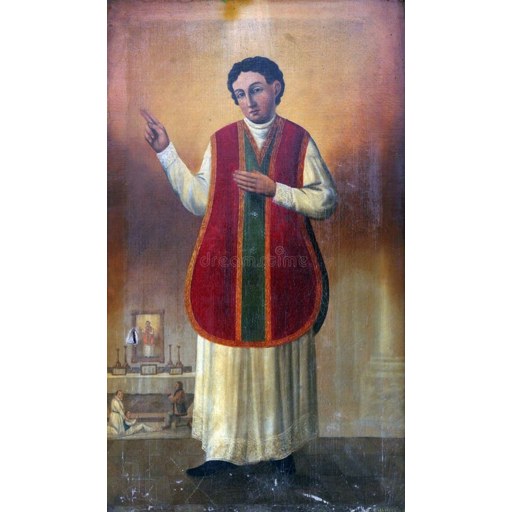
https://www.dreamstime.com/photos-images/catholic-saint-valentine.html
License: unknown
Valerian
Saint- Feast Day
- 14 April
- Gender
- male
- Church
- Catholic
Places
Roles & Family
Religious Information
Biography
Saint Valerian is venerated in the Latin Church as a Roman martyr of the third century and as the husband of Saint Cecilia. Nearly all that later ages have told of him derives from the Passio Sanctae Caeciliae, a Latin hagiographical romance that scholars generally date to the fifth century rather than to the lifetime of its protagonists. In that narrative Valerian is a young man of senatorial standing in Rome, betrothed to Cecilia, who had already bound herself by a secret vow of virginity. On the wedding night she informed him of the vow and of an angel who protected her. Valerian, according to the story, asked to see the angel and was told that he must first be cleansed by baptism. He was sent along the Appian Way to Pope Urban, who was living among the tombs because of persecution; there he received instruction and baptism. Returning home he is said to have seen the angel, who crowned both spouses with roses and lilies. Valerian then persuaded his brother Tiburtius to accept baptism as well.
The same Acts relate that the two brothers devoted themselves to burying the bodies of Christian martyrs and to almsgiving. Arrested and brought before the prefect Turcius Almachius, they refused to sacrifice to the Roman gods. They were scourged and beheaded at a place called Pagus Triopius, near the fourth milestone of the Appian Way. A custodian named Maximus, converted by their example, confessed the faith and was beaten to death. Cecilia, after further confrontation with the prefect, was condemned first to suffocation in her bathhouse and then to decapitation; the passion says she survived the sword for three days and died after commending the poor and her house to the Church. The narrative assigns these events to the pontificate of Urban I in the early third century, but it contains anachronisms and literary borrowings that prevent any confident reconstruction of a precise year of death. No independent contemporary document confirms the prefect, the place of execution, or the calendar year.
Independent of the legendary biography, the names of Valerian, Tiburtius, and Maximus entered the martyrological tradition of Rome. They are commemorated on 14 April in the Roman Martyrology, which records their passion at Rome. Medieval martyrologies of Bede, Florus, Ado, and Usuard transmitted the same date and the association with Cecilia. Liturgical calendars therefore preserve a cult that is historically more secure than the narrative details of conversion and angelic vision. Tradition places the burial of the three male martyrs in the Catacomb of Praetextatus on the Via Appia, a cemetery known for early martyr cults, while Cecilia was associated with the Catacomb of Callixtus and later with the basilica in Trastevere that bears her name. In that basilica, from the early Middle Ages onward, mosaics, inscriptions, and later Stefano Maderno's statue of Cecilia kept the memory of the virgin wife and, by extension, of Valerian as her convert spouse.
No reliable source records Valerian's year of birth, a birthplace more specific than the general Roman setting of the legend, or any civil or ecclesiastical office that he held. He was not Bishop of Rome and not a patriarch of any Eastern church. He belonged to no religious order; the Acts present him as a lay nobleman. They also present his marriage as real yet unconsummated after his conversion, and they mention no offspring. Later spiritual writers sometimes invoked the pair as an example of a marriage ordered to holiness and continence, but Valerian himself did not become the focus of a wide-ranging patronage in the way Cecilia became patron of musicians. Formal papal canonization, a procedure of a much later age, was never applied to him; his sainthood rests on ancient cult and insertion in the martyrology.
A careful historical judgment therefore holds two things together. First, the Roman Church from late antiquity onward honored martyrs named Valerian, Tiburtius, and Maximus, with a feast on 14 April and a traditional tomb in the Praetextatus cemetery. Second, the richly textured story of the wedding night, the angel, the baptism by Urban, and the prefect Almachius belongs to hagiographical literature and cannot be verified from contemporary documents. Other saints of the same name, including the fifth-century African bishop Valerian of Abbenza, are distinct figures and should not be conflated with him. Valerian remains, in the calendar and in Christian art, the companion in martyrdom and the spouse of Cecilia, a figure of the third-century Roman church as remembered by later centuries, whose personal dates and many biographical particulars are unknown.