Valerian is a saint of the Catholic Church. Valerian's feast day is celebrated on 14 April.
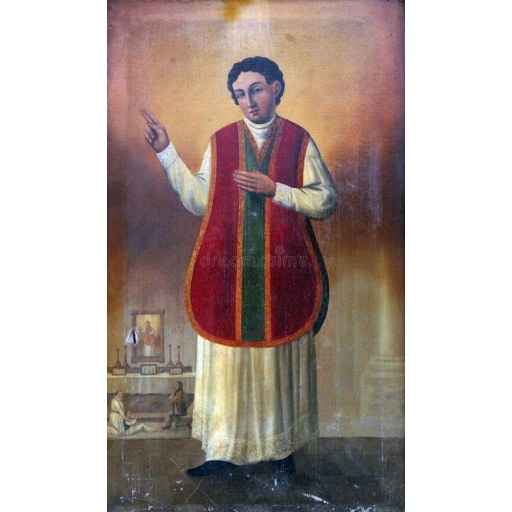
https://www.dreamstime.com/photos-images/catholic-saint-valentine.html
License: unknown
Valerian
Saint- Feast Day
- 14 April
- Gender
- male
- Church
- Catholic
Places
Roles & Family
Religious Information
Biography
Saint Valerian, also called Valerianus, is a Christian martyr of Rome whose memory is bound in Western tradition to that of Saint Cecilia, named as his wife. Nearly all that is told of him comes from the Passio Sanctae Caeciliae, a Latin hagiographical narrative generally assigned to the fifth century rather than to any contemporary record. In that account Valerian is a young pagan of distinguished Roman family, contracted in marriage to Cecilia. On the wedding night she told him that she had vowed her virginity to Christ and that an angel guarded her. When he asked to see the angel, he was instructed first to become a Christian. He was sent to Pope Urban I, then living in concealment among the tombs along the Appian Way, and there received baptism. Returning home he saw the angel, who crowned both spouses with roses and lilies. Valerian then brought his brother Tiburtius to the same faith and the same baptism. The Passio presents the marriage as a virginal one; no children are attributed to the couple.
According to the same legend the brothers devoted their means to almsgiving and, above all, to recovering and burying Christians who had been executed. That work of mercy led to their arrest. They were brought before the city prefect, named in the text as Turcius Almachius, and refused to sacrifice to the gods. After a scourging they were beheaded at a place called Pagus Triopius, near the fourth milestone of the Via Appia. Maximus, an official charged with their custody, was converted by their example, confessed the faith, and was beaten to death with leaded whips. The Passio attributes to Pope Urban the burial of Valerian, Tiburtius, and Maximus in the cemetery of Praetextatus, close to the scene of the execution. Relics later associated with them have long been claimed by the basilica of Santa Cecilia in Trastevere.
The historical value of this story is limited. An early Roman cult of Cecilia is supported by the ancient titulus Caeciliae in Trastevere and by her appearance in fifth-century liturgical sources, but Valerian, Tiburtius, and Maximus are not clearly attested outside the Passio and the cult that grew from it. Dates proposed for the martyrdom have ranged from the later second century, in the time of Marcus Aurelius, to the third century under Alexander Severus; no year can be established from reliable records. The Roman Martyrology commemorates Tiburtius, Valerian, and Maximus on 14 April, a date they also occupied in the General Roman Calendar until the revision of 1969, after which their celebration became local or optional while remaining in the Martyrology. In the East they are often remembered together with Cecilia on 22 November.
In art Valerian is commonly shown as a youthful Roman in tunic or toga, receiving a crown from an angel with Cecilia, or suffering martyrdom with Tiburtius. He is remembered as an example of conversion through a spouse’s faith and of charity in burying the dead. He has no large independent list of patronages; devotion to him is almost always joined to that of Cecilia and of his brother. Because the only connected biography is legendary, his birth year, the precise standing of his family, and the exact year of his death remain unknown. What can be affirmed is the antiquity of the Roman cult of these martyrs and the central place given to Valerian in the Cecilia legend that shaped Western liturgy, music, and iconography for many centuries.