Valerian of Abbenza is a saint of the Catholic Church (d. 457). Valerian of Abbenza's feast day is celebrated on December 15.
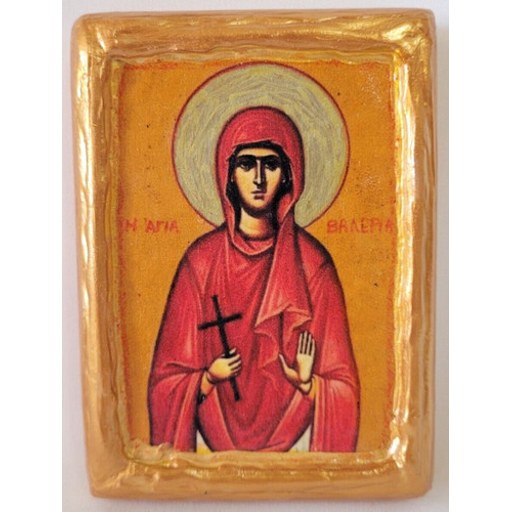
https://ebay.com/itm/186378310218
License: unknown
Valerian of Abbenza
Saint- Life Span
- d. 457
- Feast Day
- December 15
- Gender
- male
- Church
- Catholic
Roles & Family
Biography
Saint Valerian of Abbenza was a fifth-century Catholic bishop of Abbenza, an episcopal see in the Roman province of Africa Proconsularis in North Africa, in the region of present-day Tunisia. Almost nothing is known of his origins, family, education, or the date and circumstances of his consecration. He enters the historical and liturgical record solely as an aged bishop who suffered in the Vandal persecution of Nicene Christians. The Vandals, who had established a kingdom in North Africa after crossing from Spain, were largely Arian in doctrine and frequently confiscated Catholic churches and pressured Catholic clergy. Valerian's see of Abbenza, whose exact archaeological site is not securely identified, belonged to the ecclesiastical province dependent on Carthage.
According to the account preserved in the Roman Martyrology, Valerian was already more than eighty years old when he was ordered, in the persecution under the Arian Vandal king Genseric (Geiseric), to surrender the sacred vessels of his church. He refused to comply. Rather than putting so elderly a man to death at once, the authorities expelled him from the city and forbade the population to receive him into any house or to allow him to remain on private land. Deprived of shelter and hospitality, he was left to lie for a long time in the open air on the public road, where he died as a confessor of the Catholic faith. Traditional Catholic calendars and later hagiographical directories commonly date his death to 457, a conventional year associated with Genseric's reign rather than a year attested by a contemporary chronicle entry devoted specifically to Valerian.
The Roman Martyrology commemorates him on 15 December, describing his passion in Africa and his steadfastness in the defence of Catholic truth. His cult is of the ancient, pre-congregation type: he was honoured as a saint by local and Roman tradition without a surviving record of a formal papal canonization of the later medieval kind. No writings attributed to Valerian are extant, and no reliable evidence survives concerning a spouse, children, or membership in a religious order. Whether he had been married before ordination, as was still possible for some clergy in late antiquity, is simply unknown.
Valerian's stand over the sacred vessels belongs to a wider pattern of African Catholic resistance in the Vandal period, a pattern described in broader terms by the late fifth-century historian Victor of Vita in his History of the Persecution in the African Province. The vessels represented the Catholic Eucharist and the continuity of Nicene worship under Arian domination; refusal to hand them over was therefore both a disciplinary and a doctrinal act. Beyond this episode, the bishop remains an obscure figure. His memory is that of an octogenarian pastor who chose exposure and death rather than collaboration in the despoliation of his church, and who is still listed among the saints of the African church of the fifth century.