Vasile Aftenie is a blessed of the Catholic Church (1899 - 1950). Vasile Aftenie's feast day is celebrated on 2 June.
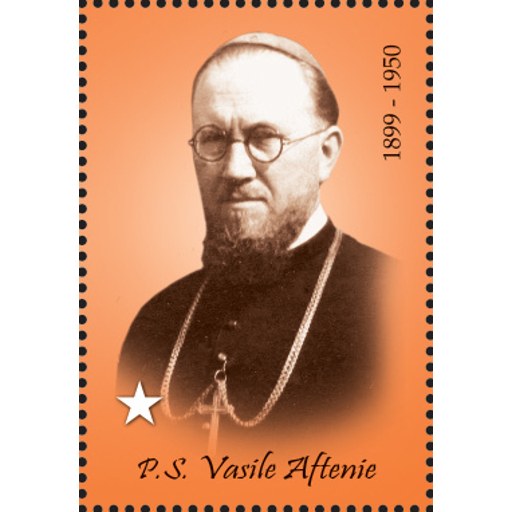
Romania Post
License: Public domain
Vasile Aftenie
Blessed- Life Span
- 1899 - 1950 (age 51)
- Feast Day
- 2 June
- Gender
- male
- Church
- Catholic
Places
Relics & Where to Venerate
Location unknown
The bodily remains of Vasile Aftenie are a first-class relic. Venerated at Bellu Cemetery.
Roles & Family
Canonization
Biography
Vasile Aftenie was a Romanian Greek-Catholic bishop and martyr of the twentieth century. He was born in 1899 in the Transylvanian village of Lodroman (in present-day Alba County, Romania), then within Austria-Hungary. He grew up in the Romanian Greek-Catholic milieu whose historic centre was nearby Blaj. After primary schooling locally he attended the Saint Basil the Great High School in Blaj, the principal educational institution of the Romanian Greek-Catholic Church. He was then sent to Rome, where he studied at the Pontifical Greek College of Saint Athanasius and completed theological studies, obtaining a doctorate. He was ordained a priest in Rome in 1926.
Returning to Transylvania, Aftenie joined the faculty of the Theological Academy in Blaj, teaching dogmatic theology, and later held responsibilities in the cathedral chapter of the Archeparchy of Făgăraș and Alba Iulia. In 1940 Pope Pius XII appointed him titular bishop of Ulpiana and auxiliary bishop of that archeparchy; he was consecrated bishop the same year. After the death of Metropolitan Alexandru Nicolescu in 1941, Aftenie was assigned to Bucharest to serve as episcopal vicar for the Greek-Catholic faithful of the capital and surrounding region, a post he held through the Second World War and the first years of communist rule.
In 1948 the Romanian communist government moved to suppress the Romanian Greek-Catholic Church, which it sought to dissolve and absorb into the Romanian Orthodox Church. A coerced clerical gathering proclaimed a “reunion” with Orthodoxy, and a subsequent decree formally outlawed the Greek-Catholic Church. The bishops refused to accept the suppression or to abandon communion with Rome. Aftenie was arrested in late October 1948 together with other members of the hierarchy. He was held at several detention sites, including Dragoslavele and the former monastery of Căldărușani, and was later transferred to Bucharest for interrogation by the Securitate, the communist secret police.
The authorities apparently hoped that the relatively young Bucharest auxiliary might be induced to submit. He was subjected to prolonged interrogation and physical torture intended to force his conversion to Orthodoxy and collaboration with the regime. He refused. He died in detention in Bucharest on 10 May 1950, at about fifty years of age, the first of the imprisoned Greek-Catholic bishops to perish. Contemporary and later testimony attributed his death to injuries and ill-treatment suffered in custody. He was buried in an unmarked grave in Bellu Cemetery in Bucharest; the grave was later identified.
The Catholic Church came to regard Aftenie’s death as martyrdom in odium fidei. On 19 March 2019 Pope Francis authorized the decree recognizing the martyrdom of Aftenie and six other Romanian Greek-Catholic bishops who died in communist imprisonment: Valeriu Traian Frențiu, Ioan Suciu, Tit Liviu Chinezu, Ioan Bălan, Alexandru Rusu, and Iuliu Hossu. They were beatified together on 2 June 2019 at Blaj, at a liturgy on the Field of Liberty presided over by Cardinal Giovanni Angelo Becciu as papal legate. Their collective liturgical memorial is kept on 2 June. Aftenie has not been canonized.