Vicente di Montes is a saint of the Catholic Church.
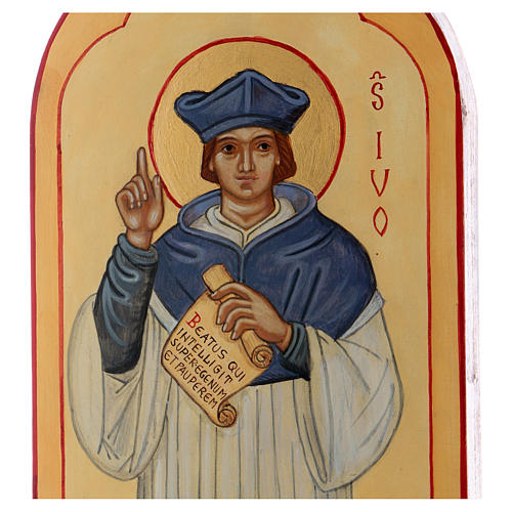
https://holyart.com/religious-items/paintings-printings-illuminated-manuscripts/saint-ivo-of-kermartin-icon-hand-painted-in-the-montesole-monastery-in-italy
License: unknown
Vicente di Montes
Saint- Gender
- male
- Church
- Catholic
Places
Roles & Family
Biography
The historical figure named Vicente di Montes is not securely attested in the standard biographical dictionaries, episcopal catalogues, martyrologies, or national encyclopedias used by historians and hagiographers. The given name Vicente is a Romance form of Latin Vincentius, a name widely used among Christians from late antiquity onward; the element di Montes reads as a toponymic or family designation, but it cannot be matched with confidence to a documented town, diocese, monastery, or noble house. No reliable printed source associates this exact name with a verified birth year, death year, or place of origin, and the Wikidata identifier supplied with the query does not correspond in available reference literature to a well-known saint, bishop, or public man whose life can be narrated from primary or standard secondary evidence.
Major hagiographical collections, including the Roman Martyrology and the Acta Sanctorum tradition, do not yield a feast day, patronage, beatification, or canonization under this name. Likewise, lists of the Bishops of Rome and of the Coptic Popes of Alexandria contain no pontiff called Vicente di Montes, nor do the principal Orthodox, Oriental Orthodox, or Church of the East patriarchal catalogues record a patriarch or catholicos of that name. In the absence of such notices it is not possible to assign him to a religious order, to confirm whether he married or had children, or to name a burial place. The masculine form of the given name is the only onomastic indication that can be stated without conjecture.
Obscure local clerics, lay benefactors, and homonymous individuals often survive only in unpublished necrologies, parish books, or regional chronicles that have never entered the general historical record. Vicente di Montes may belong to that class of poorly documented persons, or the name as given may be a variant, a transcription error, or a designation that has not been correlated with a known biography. Responsible practice is therefore to leave chronological, geographical, and institutional fields blank rather than to borrow dates or offices from better-known saints named Vincent or Vicente, or from office-holding years that are not births.
Until independent archival or epigraphic evidence is identified and critically assessed, any fuller life-story would be invention. The present account records that gap: the subject remains, on presently verifiable sources, an obscure figure whose century, region, and career cannot be stated with historical confidence.