Victor of Chalcedon is a saint of the Catholic Church.
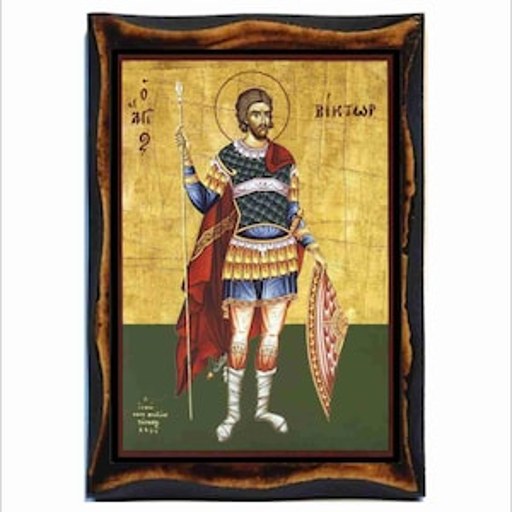
https://www.etsy.com/market/saint_victor_icon
License: unknown
Victor of Chalcedon
Saint- Gender
- male
- Church
- Catholic
Roles & Family
Biography
Victor of Chalcedon is a little-known figure in Christian hagiography, associated by name with the ancient city of Chalcedon in Bithynia, on the Asian shore of the Bosporus opposite Constantinople (the site of modern Kadıköy in Turkey). Reliable late-antique and medieval sources do not preserve a connected Life, passio, or episcopal notice that would allow historians to reconstruct his dates, family, or precise role. He is readily confused in later lists with more famous saints named Victor, including Pope Victor I of the late second century, the martyr Victor of Marseilles, Victor of Vita the African historian-bishop, and the soldier-martyr Victor commemorated with Corona or Stephanida. No such identification can be demonstrated for the Chalcedonian Victor from independent evidence.
The city of Chalcedon itself was an important Christian center from the early centuries. It possessed a bishop by the fourth century at latest and hosted the Fourth Ecumenical Council in 451, which issued the Chalcedonian Definition concerning the two natures in Christ. The local church venerated Saint Euphemia as its great martyr, and the region of Bithynia produced numerous other martyrs and bishops during the persecutions of the third and early fourth centuries and in later doctrinal conflicts. A cleric, monk, or martyr named Victor could plausibly have belonged to this milieu, but the mere epithet of Chalcedon does not by itself establish whether the subject was a native of the city, a bishop of the see, or a person who died there.
Standard Western martyrologies, including the Hieronymian Martyrology and the Roman Martyrology, and the principal Greek synaxaria do not, in their critically edited forms, furnish an unambiguous feast day, burial site, or set of patronages that can be assigned with confidence to this Victor. Where the name Victor appears in connection with Bithynia or the Propontis, the notices are typically brief, late, or susceptible of being doublets of other entries. Consequently, claims of a specific century of death, a particular form of martyrdom, or membership in a later religious order cannot be verified from independent historical evidence.
No source of adequate authority indicates that Victor of Chalcedon occupied the see of Rome or any of the patriarchal thrones of the East (Constantinople, Alexandria, Antioch, or Jerusalem). The bishopric of Chalcedon, though later raised in dignity within the Constantinopolitan hierarchy, was never itself a patriarchate. Likewise, there is no documented evidence of a spouse or of children, nor of a formal religious profession in a named order. Burial at Chalcedon is a reasonable conjecture only if he died locally, but it remains unproven.
In the present state of the evidence, therefore, Victor of Chalcedon must be treated as an obscure name attached to an important early Christian city. A responsible historical account can describe the setting of Chalcedon and the frequency of the name Victor among late-Roman Christians, but it cannot supply a birth year, a death year, or a detailed curriculum vitae without resorting to conjecture. Further progress would depend on the discovery of an inscription, a dated conciliar signature, or an early hagiographical text that explicitly and uniquely identifies a Victor with Chalcedon.