Victor of Marseilles is a saint of the Catholic Church (d. 290). Victor of Marseilles's feast day is celebrated on 21 July. Victor of Marseilles is the patron saint of Marseille;millers.
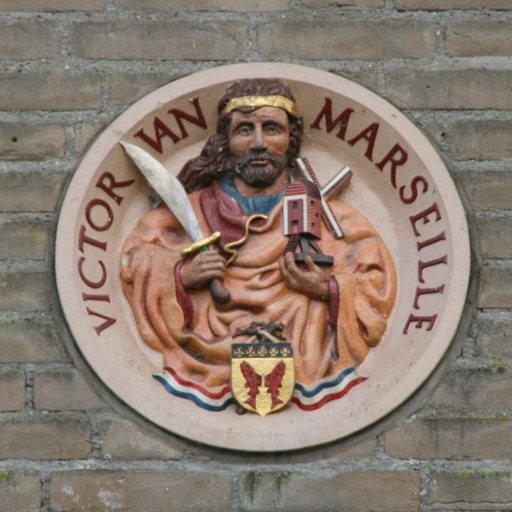
Quistnix at Dutch Wikipedia
License: CC BY-SA 2.5
Victor of Marseilles
Saint- Life Span
- d. 290
- Feast Day
- 21 July
- Gender
- male
- Church
- Catholic
Places
Sacred Place

Roles & Family
Patronage
Marseille;millers
Biography
Victor of Marseilles is a Christian martyr of the late Roman period whose cult became central to the religious identity of Marseille. He is traditionally described as a soldier in the Roman army who was put to death at Massilia, the ancient name of Marseille, during persecutions associated with the reign of the emperor Maximian. No contemporary administrative or literary source records his trial, and the narrative of his passion survives only in later hagiographical texts that mix conventional martyr tropes with local tradition. Historians therefore treat the detailed story with caution while generally accepting that a martyr named Victor was venerated at Marseille from an early date, and that his tomb became a focus of Christian devotion in late antique Gaul.
The received legend presents Victor as an officer who refused to participate in pagan sacrifice. Arrested and imprisoned, he is said to have converted three of his guards, commonly named Longinus, Alexander, and Felician, who were themselves executed for becoming Christians. Victor was then subjected to prolonged torture. In a well-known episode he was taken into a temple and ordered to burn incense before a statue of Jupiter; instead he overturned or kicked down the image. As punishment he was crushed under a millstone, an instrument that later became his principal iconographic attribute and the basis of his patronage of millers. After further sufferings, including in some versions the severing of a foot, he was beheaded. The traditional date assigned to these events is 290, though some later writers connected them with the wider Great Persecution under Diocletian a little more than a decade afterward.
Local Christians recovered the martyr’s body and laid it in a cave or rock-cut tomb outside the city walls. In the early fifth century John Cassian, the monk and spiritual writer who had settled in Provence, established a monastery over this burial place. That house, known as the Abbey of Saint-Victor, grew into one of the leading monastic institutions of medieval southern France. Its crypt, believed to contain Victor’s tomb, attracted pilgrims throughout the Middle Ages. The abbey’s prestige helped to spread Victor’s cult through Provence and beyond, and churches dedicated to him appeared in various regions of Europe. He is commemorated on 21 July in the Roman Martyrology and in numerous local calendars, and he is likewise remembered in Eastern Christian usage.
Victor is honoured as the principal patron saint of Marseille, a role acknowledged in the city’s religious and civic life for many centuries. Because of the millstone associated with his martyrdom he is also invoked as a patron of millers. In Christian art he is typically shown as a Roman soldier, often with a millstone, a sword, or a palm of martyrdom. Although the passio cannot be used as a straightforward historical record, the continuity of his cult from late antiquity, the foundation of Saint-Victor over his tomb, and his enduring place in the liturgy of Gaul constitute the verifiable core of his memory. He was never the object of a formal papal canonization of the later medieval or modern type; his status as a saint rests on ancient popular and liturgical veneration, later confirmed by inclusion in the martyrologies of the Western Church.