Victorinus is a saint of the Catholic Church. Victorinus's feast day is celebrated on 2 November.
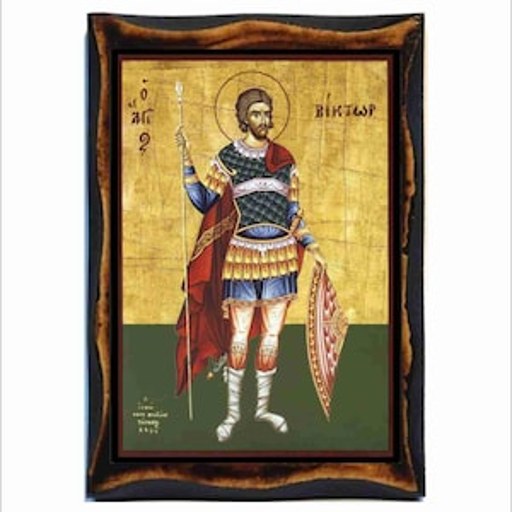
https://www.etsy.com/market/saint_victor_icon
License: unknown
Victorinus
Saint- Feast Day
- 2 November
- Gender
- male
- Church
- Catholic
Places
Roles & Family
Biography
Victorinus of Pettau, known in Latin as Victorinus Petavionensis, was bishop of Poetovio, a Roman city on the Drava in the province of Pannonia (later Pettau, now Ptuj in Slovenia), in the later third century. He is the earliest Latin ecclesiastical writer whose work as a biblical commentator survives in identifiable form, and he died a martyr in the persecution begun under the emperor Diocletian. No contemporary biography exists. The principal ancient notice is the brief chapter that Jerome devoted to him in De viris illustribus near the end of the fourth century. Jerome states that Victorinus was bishop of Poetovio, that he was not equally skilled in Latin and in Greek, and that he received the crown of martyrdom. From the remark on language, later writers have often inferred that Greek was his stronger tongue and that he may have come from the Greek-speaking East, but Jerome names neither a birthplace nor a year of birth, and those details remain unknown.
Jerome attributes to him a large exegetical corpus: commentaries on Genesis, Exodus, Leviticus, Isaiah, Ezekiel, Habakkuk, Ecclesiastes, the Song of Songs, and the Apocalypse of John, together with a work against all heresies and numerous other writings. Almost all of this output has been lost. The Commentary on the Apocalypse is the only substantial text that can still be read as essentially his, although it too was later revised. Fragments and later citations give only glimpses of the rest. Victorinus thus stands as the first in the line of Latin biblical commentators, writing a generation or more before Hilary of Poitiers and Ambrose of Milan produced their own exegetical works.
The surviving Apocalypse commentary is of great interest for the history of interpretation. Victorinus read the Book of Revelation along chiliastic or millenarian lines, expecting a future earthly reign of Christ lasting a thousand years, a hope earlier expressed by writers such as Papias, Justin, Irenaeus, and Hippolytus. He also used a recapitulative method, treating successive visions as overlapping rather than as a strictly linear sequence of future events. In the late fourth century Jerome issued an edited version of the commentary in which millenarian passages were modified or suppressed, in keeping with the growing rejection of chiliasm in the post-Nicene church. Medieval readers generally knew Victorinus through this Hieronymian recension. Modern scholarship has distinguished the original layer from Jerome’s revisions and has noted Victorinus’s dependence on Greek predecessors, including Irenaeus, Hippolytus, and possibly Origen.
Victorinus’s Latin style was judged by Jerome to be rough and inferior to the quality of his thought. That judgment reflects both his apparent greater familiarity with Greek and the still-developing state of Christian Latin prose in the third century. He wrote for a church on the Danubian frontier, far from the literary centres of Rome, Carthage, or Alexandria, and his work shows a pastor and teacher concerned with Scripture and with the refutation of heresy rather than with rhetorical display.
He was put to death during the Diocletianic persecution, an event placed by later tradition in 303 or 304. The Roman Martyrology commemorates him on 2 November as bishop and martyr at Pettau in Pannonia. His veneration is ancient and belongs to the era before formal papal canonization; no individual canonizer or beatifier is recorded. He is not commonly named as patron of particular cities, professions, or causes. Even with so many of his books lost and so few personal facts preserved, Victorinus remains a central witness to Latin Christianity in the third century and to the earliest stage of Western biblical exegesis.