Victorinus of Assisi is a saint of the Catholic Church.
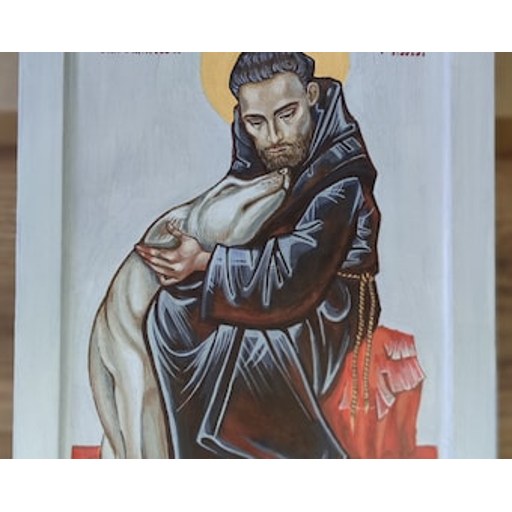
https://etsy.com/listing/537591316/st-francis-of-assisi-modern-icon-5x7
License: unknown
Victorinus of Assisi
Saint- Gender
- male
- Church
- Catholic
Roles & Family
Biography
Victorinus of Assisi belongs to the shadowy company of early Christian figures attached by later tradition to the Umbrian hill town of Assisi. Almost nothing about him can be established from sources written in his own lifetime or in the immediately following generations. No contemporary inscription, no notice in Eusebius of Caesarea, no letter of a Roman bishop, and no securely early passio can be cited that names a Victorinus as bishop or martyr of Assisi. The historian is therefore obliged to distinguish carefully between the later liturgical and local memory of such a person and the meagre residue of verifiable fact.
Assisi in the third and fourth centuries was a modest municipium in the sixth Augustan region of Italy. Christianity reached Umbria in the course of the third century, and the city later claimed an early bishop-martyr in Saint Rufinus, whose cult is attested by the dedication of the cathedral and by medieval hagiography. Lists of Assisi’s bishops compiled in the Middle Ages sometimes include additional names from the persecutions. A Victorinus appearing in such lists, if the identification is not simply a duplication or a transfer of another martyr’s name, would belong to that legendary or semi-legendary stratum rather than to a documented episcopal succession. Critical hagiography has long recognized that many Italian sees filled the gaps in their early history with conventional martyr-bishops placed under Decius or Diocletian.
The personal name Victorinus was widespread in the Latin West in the later Empire; it is borne by the better-documented Victorinus of Pettau, the exegete and martyr of Pannonia, and by various African and Roman martyrs in the Hieronymian Martyrology. Confusion or local appropriation of such names is a known phenomenon in the transmission of cults. Whether the Assisi Victorinus is an independent local saint, a doublet of another Victorinus, or a medieval addition to the city’s sacred history cannot be decided on present evidence. No birthplace, parentage, year of birth, or detailed circumstances of death survive that meet ordinary standards of historical verification.
In the later Middle Ages the religious identity of Assisi was transformed by the lives of Francis and Clare. The Franciscan movement, the basilica of Saint Francis, and the worldwide expansion of those cults overshadowed the memory of the town’s earlier patrons, with the partial exception of Rufinus. Any medieval feast of Victorinus, if it was observed locally, left little trace in the universal calendars that became standard after the Tridentine reform of the Martyrology. Modern popular saint lists occasionally assign him a feast day and a death under Diocletian, but those details reproduce unverified tradition rather than archival discovery.
Consequently a responsible biographical notice can say only that Victorinus of Assisi is remembered in some Catholic and local traditions as an early bishop or martyr connected with Assisi in Umbria; that his historical existence and dates remain unconfirmed; and that no reliable information exists concerning his family, education, pastoral acts, or the precise manner of his death. Further light would depend on the recovery of early liturgical books, inscriptions, or critically edited medieval texts that have not so far been brought to bear on this particular name.