Victricius is a saint of the Catholic Church. Victricius's feast day is celebrated on 7 August.
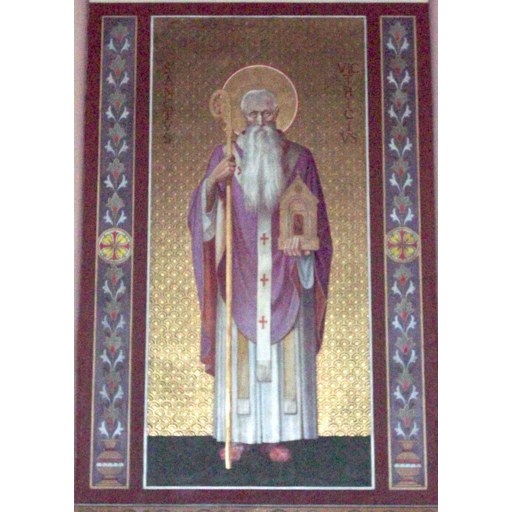
Giogo
License: CC BY-SA 3.0
Victricius
Saint- Feast Day
- 7 August
- Gender
- male
- Church
- Catholic
Places
Roles & Family
Biography
Victricius (known in French as Victrice) was a Gallo-Roman bishop of Rouen in the later fourth and early fifth centuries, remembered as a former soldier, a missionary in still-pagan districts of northern Gaul, an early Latin theorist of the cult of relics, and a correspondent of Martin of Tours, Paulinus of Nola, and Pope Innocent I. Almost nothing certain is known of his family or place of birth. Later tradition and the notices of contemporaries indicate that he served in the Roman army and that, after converting to Christianity, he refused to continue in military service. For that refusal he was flogged and condemned to death; the sentence was not carried out. Thereafter he left the army and devoted himself to preaching.
In the following years he worked as a missionary among peoples of northern Gaul who were still largely outside the Church, including the Nervii and the Morini, in territories that later corresponded to parts of northern France and the Low Countries. He belonged to the same ascetic and episcopal circle as Martin of Tours and appears to have imitated Martin’s combination of missionary preaching, monastic discipline, and care for the poor. By the last decade of the fourth century he had been made bishop of Rouen. From that see he sought to organize clerical life, to foster monastic communities in his diocese, and to obtain relics of the saints for the churches of the city. Paulinus of Nola addressed him with warm praise as a fellow bishop formed in the same spiritual school as Martin.
Around the mid-390s Victricius crossed to Britain at the invitation of the British clergy in order to help compose a dispute among bishops there, an episode recorded by Paulinus. In the same period he received a consignment of relics sent from Italy, an event that occasioned the sermon later circulated under the title De laude sanctorum (In Praise of the Saints). That work is one of the most important surviving Latin discussions of relic theology. Victricius argues that the saints are truly present in their remains, that divine power is not lessened by being shared among many shrines, and that veneration of the saints expresses the unity of the Church as the body of Christ. The sermon also documents the late antique practice of translating relics from Italy and the Mediterranean world to the churches of Gaul, and it shows Victricius as a bishop eager to bind his northern see to the communion of the Italian churches.
In the early fifth century he was accused of heresy. The exact nature of the charge is not clearly preserved. He travelled to Rome to defend his orthodoxy and to ask for rulings on a range of disciplinary questions affecting his church. Pope Innocent I replied in 404 with a substantial decretal letter addressed to Victricius, treating the grades of clergy, the administration of baptism and related rites, and the teaching authority of the Roman see. The letter became an important text in the later canonical tradition. Victricius died not long afterwards, in the first years of the fifth century, almost certainly at Rouen. He was commemorated there as a saint; his feast is kept on 7 August. Apart from De laude sanctorum and Innocent’s letter, the chief contemporary witnesses to his life are the correspondence of Paulinus of Nola and later Gallic ecclesiastical notices. Precise years of birth and death are not securely attested.