Vincent is a saint of the Catholic Church.
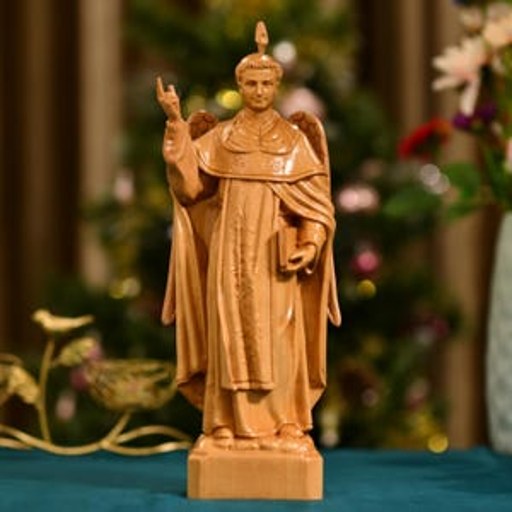
https://www.etsy.com/market/st_vincent_icon
License: unknown
Vincent
Saint- Gender
- male
- Church
- Catholic
Biography
The single given name Vincent (Latin Vincentius, from vincere, “to conquer”) is borne by many distinct historical and hagiographical figures. The query supplies no Wikidata identifier, no encyclopedia article, no epithet, no century, and no see or religious order. Under those conditions a unique person cannot be fixed in the historical record, and it would be unsound to treat any one Saint Vincent as “the” subject. Martyrologies, acta, and modern dictionaries of saints therefore keep the bearers of the name separate; merging their dates, cults, or offices would be conjecture rather than verification.
Among the better-documented Christian figures of this name, late Roman Hispania commemorates Vincent of Saragossa (also called Vincent the Deacon), a deacon associated with Bishop Valerius and remembered as a victim of the Diocletianic persecution in the early fourth century; his cult spread widely in the medieval West. Fifth-century Gaul produced Vincent of Lérins, a monk of the island monastery of Lérins and author of the Commonitorium, a work on the rule of faith. The later Middle Ages and early modern period add, among others, Vincent Ferrer, a Dominican preacher active during the Western Schism, and Vincent de Paul, a French priest of the seventeenth century whose name is attached to organized charity and clerical formation. Each of these men belongs to a different region, century, and ecclesiastical setting; their feast days, burial traditions, and patronages do not coincide.
Because those biographies cannot be assigned to an undifferentiated “Vincent,” fields that require a single life—year of birth, year of death, places of birth and death, burial, religious order, spouse, children, papal or patriarchal office, feast day, patronage list, and agents of beatification or canonization—are left empty. No Bishop of Rome or Coptic Pope of Alexandria named Vincent is a standard identification that could be applied here, but the absence of a disambiguator also forbids a confident negative for every possible office. The masculine grammatical form of Vincentius and the historical usage of Vincent as a male baptismal name in Latin Christianity support recording gender as male for the name as given; that is a linguistic and onomastic observation, not a full identification of a person.
What can be stated with caution is only this: Christian tradition knows numerous holy and clerical Vincents, especially in the Latin West from late antiquity through the early modern period, and popular devotion has attached different local and professional patronages to different ones (for example, Vincent of Saragossa in parts of the Iberian world and Vincent de Paul in connection with charitable works). None of those cults or dates is verified for the present unnamed subject. Anyone seeking a particular Vincent should supply a traditional qualifier (place, order, or surname), a feast, or a catalogue identifier so that chronology and geography can be checked against critical hagiography rather than assumed from the name alone.