Vincent Ferrer is a saint of the Catholic Church (1350 - 1419). Vincent Ferrer's feast day is celebrated on 5 April. Vincent Ferrer is the patron saint of builders;construction workers;plumbers;tile makers;brickmakers;pavement workers;Valencia;Valencian Community;Vannes;Castellón de la Plana.
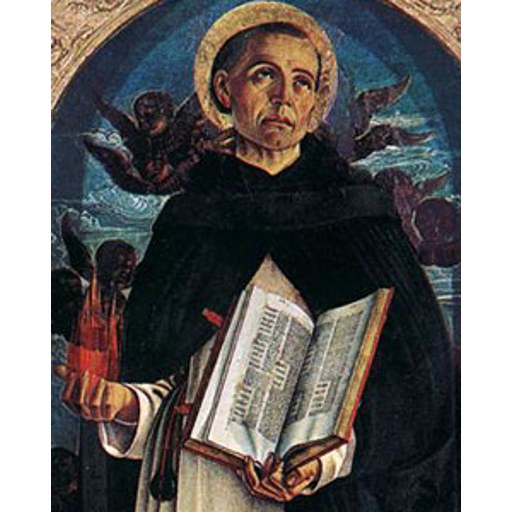
Giovanni Bellini
License: Public domain
Vincent Ferrer
Saint- Life Span
- 1350 - 1419 (age 69)
- Feast Day
- 5 April
- Gender
- male
- Church
- Catholic
Places
Roles & Family
Religious Information
Patronage
builders;construction workers;plumbers;tile makers;brickmakers;pavement workers;Valencia;Valencian Community;Vannes;Castellón de la Plana
Canonization
Biography
Vincent Ferrer (Vicent Ferrer in Valencian) was born in 1350 in Valencia, capital of the Kingdom of Valencia in the Crown of Aragon. His father, Guillem Ferrer, was a notary of Catalan origin, and his mother, Constança Miquel, came from a Valencian family. The household was devout and relatively prosperous. At about seventeen, in 1367, he entered the Dominican convent in Valencia. After profession he studied logic, philosophy, and theology in the order’s schools and later lectured at Dominican houses in Barcelona, Lleida, and other towns of the Crown of Aragon. He was ordained a priest in the later fourteenth century and became known for personal austerity, long hours of prayer, and unusual eloquence in the pulpit. He remained a simple friar throughout his life and never accepted a bishopric.
The Western Schism that began in 1378 shaped much of his public career. Ferrer adhered to the Avignon obedience and became a close associate of Cardinal Pedro de Luna. When Luna was elected as Benedict XIII in 1394, Ferrer served as his confessor and theological adviser at Avignon and later at Peñíscola, and he wrote in defense of that claimant. As the schism dragged on and Benedict refused every proposal of resignation, Ferrer’s stance changed. He left the Avignon court and, by the years of the Council of Constance (1414–1418), used his prestige as a preacher to urge the rival popes to stand down and to restore unity. In Aragonese politics he was one of the nine compromisarios at Caspe in 1412 who chose Ferdinand of Antequera as king, a settlement that helped stabilize the Crown of Aragon after a disputed succession.
From about 1399 until his death he lived as an itinerant missionary rather than a conventual professor. Accompanied by clergy, lay penitents, and at times flagellants, he preached across the Iberian kingdoms, southern and western France, the Swiss lands, northern Italy, and finally Brittany. He customarily preached in Catalan, which was widely understood in Mediterranean Europe, with interpreters where needed. Contemporary chroniclers describe enormous open-air crowds, public confessions, the reconciliation of feuds, and large numbers of conversions among Jews and Muslims as well as the moral reform of Christian audiences. His sermons dwelt on repentance, the Last Judgment, and preparation for the end times. He became popularly known as the Angel of the Judgment, and later artists often showed him with wings. Hagiographical sources attribute numerous miracles and prophecies to these journeys; modern historians treat those claims with caution while acknowledging his exceptional influence as a late medieval revival preacher. He also left written works, including a treatise on the schism and a treatise on the spiritual life.
Ferrer spent his last years in the Duchy of Brittany, where Duke John V had invited him. He continued to preach until shortly before his death at Vannes on 5 April 1419 and was buried in the cathedral there, which became a focus of his cult. Devotion spread rapidly in Brittany, the Crown of Aragon, and the Dominican Order. Pope Callixtus III, himself a Valencian (Alfonso de Borja), canonized him on 3 June 1455. His feast is kept on 5 April. He remains one of the most prominent saints of the late medieval Dominican Order and a principal patron of Valencia and the Valencian Community, of Vannes, and of builders and related construction trades. His life illustrates both the power of popular preaching in the later Middle Ages and the entanglement of sanctity, politics, and the crisis of the papacy during the Great Schism.