Vincent the Levite is a saint of the Catholic Church (d. 304). Vincent the Levite's feast day is celebrated on 22 January. Vincent the Levite is the patron saint of Valencia;Lisbon;Vicenza;Portugal;vintners;winegrowers;vinegar-makers;brickmakers;sailors.
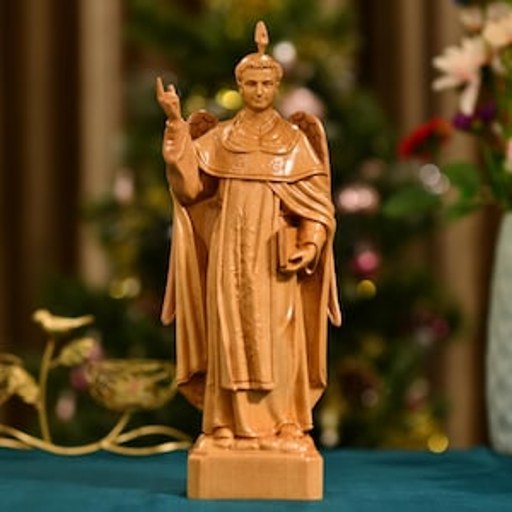
https://www.etsy.com/market/st_vincent_icon
License: unknown
Vincent the Levite
Saint- Life Span
- d. 304
- Feast Day
- 22 January
- Gender
- male
- Church
- Catholic
Places
Roles & Family
Patronage
Valencia;Lisbon;Vicenza;Portugal;vintners;winegrowers;vinegar-makers;brickmakers;sailors
Biography
Vincent, often styled Vincent the Levite because early Christian Latin used levita for a deacon, was a cleric of the church of Zaragoza in Roman Hispania. He served under Bishop Valerius in the later third and early fourth centuries. When the persecution associated with the emperor Diocletian was enforced in Spain by the prefect Dacian, bishop and deacon were arrested and taken to Valencia. Valerius, who suffered from a speech impediment, was sent into exile; Vincent, who had spoken in his bishop’s place, was kept for interrogation and torture. No contemporary record gives his year of birth. Later medieval tradition, reported in standard hagiographical collections, places his origin at Huesca.
The earliest substantial literary witness is the hymn of the Spanish poet Prudentius, written toward the end of the fourth century, which already treats Vincent as a famous martyr. Subsequent Latin passions describe a sequence of torments: he was stretched on the rack, torn with iron hooks, and laid upon a heated gridiron, remaining constant and even joyful in his confession. After a night in a prison whose floor was strewn with broken pottery, he died of his wounds, traditionally in 304. Later legend added that his body was exposed to beasts or cast into the sea, yet was preserved and recovered for Christian burial at Valencia.
The cult spread with unusual speed across the Latin West. Augustine of Hippo preached sermons on Vincent’s feast in North Africa, and churches dedicated to him appeared in Gaul, Italy, and Africa already in the fifth century. In the twelfth century a portion of the relics was translated to Lisbon, which adopted him as principal patron. Valencia likewise regards him as its patron. His feast on 22 January has been observed throughout the Catholic Church from an early date. Popular etymology linking his name with wine made him a patron of vintners, winegrowers, and vinegar-makers; he is also invoked by brickmakers and sailors, and as a patron of Vicenza and of Portugal.
Vincent belonged to the diocesan clergy of Zaragoza and is not known to have entered any monastic order. The sources are silent about marriage or children. Because his veneration is of great antiquity, he was never formally canonized by a pope according to the procedures that developed in the later Middle Ages. Historical knowledge of his life rests on liturgical commemoration, the poetry of Prudentius, and the later hagiographical tradition rather than on archival records.