Virgin is a saint of the Catholic Church. Virgin's feast day is celebrated on August 15. Virgin is the patron saint of mothers;virgins;the Church;families;the Americas;Mexico;Poland;the Philippines;France;sailors;the sick;women in childbirth.
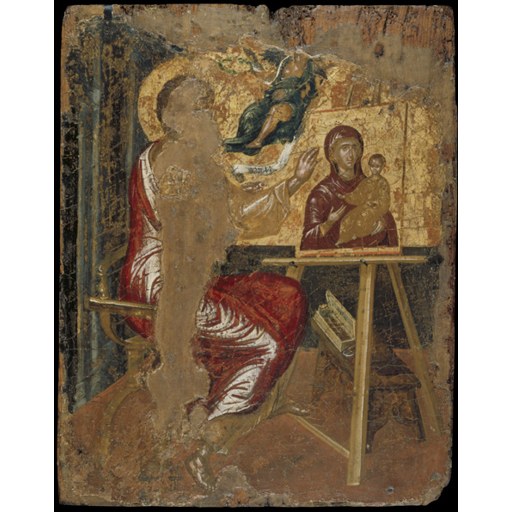
https://www.italianrenaissanceresources.com/units/unit-1/essays/saint-luke-paints-the-virgin-and-child-genealogy-of-an-image/
License: unknown
Virgin
Saint- Feast Day
- August 15
- Gender
- female
- Church
- Catholic
Places
Roles & Family
Religious Information
Patronage
mothers;virgins;the Church;families;the Americas;Mexico;Poland;the Philippines;France;sailors;the sick;women in childbirth
Biography
The Virgin Mary, known in Christian tradition as the Blessed Virgin Mary, Saint Mary, or the Theotokos, is the mother of Jesus of Nazareth according to the New Testament. The canonical Gospels present her as a young Jewish woman of Nazareth in Galilee, betrothed to Joseph, a carpenter of Davidic descent. The Gospel of Luke recounts that the angel Gabriel appeared to her with the announcement that she would conceive a son by the Holy Spirit, to be called Jesus, the Son of the Most High. She consented with the words of the Magnificat later sung during her visit to her kinswoman Elizabeth, mother of John the Baptist. Matthew’s Gospel adds the account of Joseph’s dream, the birth in Bethlehem, the visit of the Magi, and the flight into Egypt to escape Herod. These infancy narratives form the core of what can be known of her from first-century sources.
Mary appears at several subsequent moments in the Gospel accounts of Jesus’ public life. At the wedding in Cana she intercedes when the wine fails, prompting Jesus’ first sign. She is present among the women who follow Jesus, and she stands at the foot of the Cross, where Jesus commends her to the beloved disciple. The Acts of the Apostles places her with the Eleven and other disciples in the upper room at Pentecost. Extra-canonical writings, especially the second-century Protoevangelium of James, supply later traditions concerning her parents Joachim and Anne, her presentation in the Temple as a child, and her perpetual virginity. These texts, while influential in liturgy and art, are not regarded as historically contemporaneous with the events they describe.
From the fourth century onward, councils and theologians developed a rich mariological doctrine. The Council of Ephesus in 431 affirmed the title Theotokos, God-bearer, against Nestorian objections. Eastern Christianity commemorates her Dormition; the Latin Church later defined the Immaculate Conception (1854) and the Assumption (1950) as dogmas, holding that she was preserved from original sin from the first instant of her conception and that at the close of her earthly life she was taken body and soul into heaven. No contemporary record establishes a precise year or place of death; traditions locate her last years either in Jerusalem or at Ephesus. Because of the doctrine of the Assumption, no bodily relics are claimed, though a tomb in the Kidron Valley has been venerated since late antiquity.
Devotion to Mary spread rapidly through the Christian world. She became the most frequently depicted figure in Christian art after Christ himself, the subject of countless hymns, litanies, and feast days, and the reported source of major apparitions at Guadalupe, Lourdes, Fatima, and elsewhere. Entire nations and countless local churches, guilds, and causes have placed themselves under her patronage. While strictly historical data outside the New Testament remain sparse, her place in Christian memory, liturgy, and popular piety has been continuous from the earliest centuries of the Church.