Virgin is a saint of the Catholic Church. Virgin's feast day is celebrated on 8 September (Nativity); 25 March (Annunciation); 15 August (Assumption/Dormition); 8 December (Immaculate Conception); 1 January (Mary, Mother of God); 2 February (Presentation). Virgin is the patron saint of the Catholic Church;mothers;virgins;families;the United States;Mexico;France;Poland;Portugal;Spain;Italy;the Philippines;Brazil;Argentina;Chile;Ireland;Hungary;Australia;seafarers.
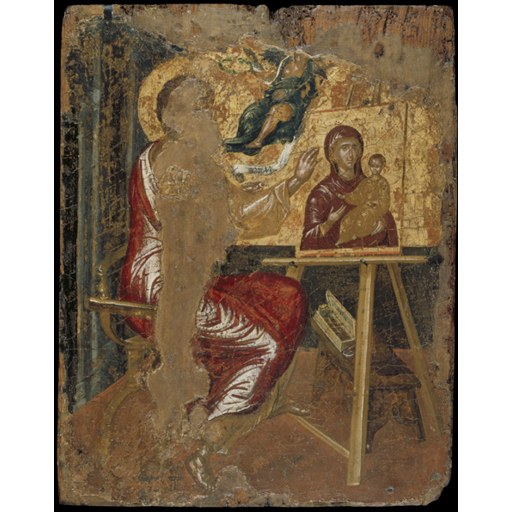
https://www.italianrenaissanceresources.com/units/unit-1/essays/saint-luke-paints-the-virgin-and-child-genealogy-of-an-image/
License: unknown
Virgin
Saint- Feast Day
- 8 September (Nativity); 25 March (Annunciation); 15 August (Assumption/Dormition); 8 December (Immaculate Conception); 1 January (Mary, Mother of God); 2 February (Presentation)
- Gender
- female
- Church
- Catholic
Roles & Family
Religious Information
Patronage
the Catholic Church;mothers;virgins;families;the United States;Mexico;France;Poland;Portugal;Spain;Italy;the Philippines;Brazil;Argentina;Chile;Ireland;Hungary;Australia;seafarers
Biography
The figure known throughout Christian tradition as the Virgin, or the Blessed Virgin Mary, is the mother of Jesus of Nazareth and the most widely venerated woman in the history of Christianity. The canonical Gospels present her as a Jewish woman of Nazareth in Galilee, betrothed to Joseph, a man of Davidic descent. In the Gospel of Luke, the angel Gabriel announces that she will conceive by the Holy Spirit and bear a son to be named Jesus; she consents with the words 'let it be to me according to your word.' Luke further records her journey to the hill country of Judea to visit her kinswoman Elizabeth, the hymn known as the Magnificat, the birth of Jesus at Bethlehem during a registration associated with the Roman administration of Syria, the presentation of the child in the Temple, and the later episode in which the twelve-year-old Jesus is found among the teachers. The Gospel of Matthew narrates Joseph's dream concerning her pregnancy, the visit of the Magi, the flight into Egypt to escape Herod, and the family's settlement at Nazareth. The Gospel of John places Mary at the wedding at Cana, where Jesus performs his first public sign at her intercession, and at the crucifixion, where he commends her to the care of the beloved disciple. The Acts of the Apostles mention her among the disciples gathered in prayer in Jerusalem after the Ascension.
Outside these New Testament notices, virtually nothing about her biography can be established from contemporary historical sources. First-century Nazareth was a small Galilean village under Herodian and then Roman rule; no civil archives, inscriptions, or non-Christian literary references to Mary survive from her lifetime. The names of her parents, Joachim and Anne, the story of her own childhood presentation in the Temple, and many details of her later years derive from the second-century Protoevangelium of James and related apocryphal writings. Those texts shaped liturgy, feast days, and art across East and West, but they are not independent historical records. Traditions concerning her birthplace conflict between Nazareth and Jerusalem. Traditions concerning the end of her earthly life likewise conflict: one localizes her dormition and empty tomb in the Kidron Valley at Jerusalem; another associates her last years with Ephesus in Asia Minor. Catholic and Eastern Orthodox doctrine holds that she remained a virgin before, during, and after the birth of Jesus. The brothers and sisters of Jesus mentioned in the Gospels are interpreted in those churches as cousins or as children of Joseph by an earlier marriage. Other Christian traditions have understood those siblings as Mary's children born after Jesus. No year of birth or of death is given in any early source that meets ordinary historical criteria, and later legendary dates are not reliable.
Doctrinal reflection on Mary developed over the first five centuries of the Church and continued in later definitions. She was called Theotokos, God-bearer or Mother of God, a title already in liturgical and theological use before it was solemnly defined against Nestorius at the Council of Ephesus in 431. The Council of Chalcedon in 451 reaffirmed that title in its Christological definition. Eastern and Western fathers wrote of her unique holiness and her consent as the human condition of the Incarnation. In the Latin Church the Immaculate Conception, the belief that she was preserved from original sin from the first moment of her conception, was defined as dogma by Pope Pius IX in 1854. The Assumption, the belief that at the end of her earthly life she was taken body and soul into heavenly glory, was defined as dogma by Pope Pius XII in 1950; the Christian East commemorates the same mystery as the Dormition of the Theotokos. She was never the object of a formal canonization process of the later medieval or modern type. Her cult is as old as the Church itself and is attested in second-century writings, in Roman catacomb painting, and in the oldest surviving liturgical calendars of East and West.
Devotion to the Virgin has taken innumerable local and universal forms. Major Marian feasts shared widely among Catholics and Orthodox include her Nativity on 8 September, the Annunciation on 25 March, the Presentation or Purification on 2 February, and the Assumption or Dormition on 15 August. The Roman calendar also keeps the Immaculate Conception on 8 December and the Solemnity of Mary, Mother of God, on 1 January. Popular piety has centered on the rosary, various scapulars, litanies, and pilgrimages. Apparitions reported at Guadalupe in the sixteenth century, at Lourdes in the nineteenth, and at Fatima in the twentieth, among many others, have generated further titles, shrines, and national patronages. She is invoked as patroness of the universal Church and of a great number of nations, dioceses, cities, religious institutes, and states of life, including mothers, virgins, and Christian families. The Reformation sharply reduced public Marian cult in most Protestant lands, while Catholic reform, baroque piety, and the unbroken liturgical life of the Eastern churches continued and expanded it. Titles such as Our Lady, Madonna, Panagia, and Theotokos, together with countless local epithets, reflect the breadth of this cultus.