Virgin is a saint of the Catholic Church. Virgin's feast day is celebrated on 15 August (Assumption/Dormition); 8 September (Nativity); 25 March (Annunciation); 1 January (Mary, Mother of God). Virgin is the patron saint of mothers;virgins;the United States;Mexico;the Americas;France;Poland;Portugal;the Philippines;Brazil;Argentina;Spain;Italy;Ireland;Hungary;mariners;travelers.
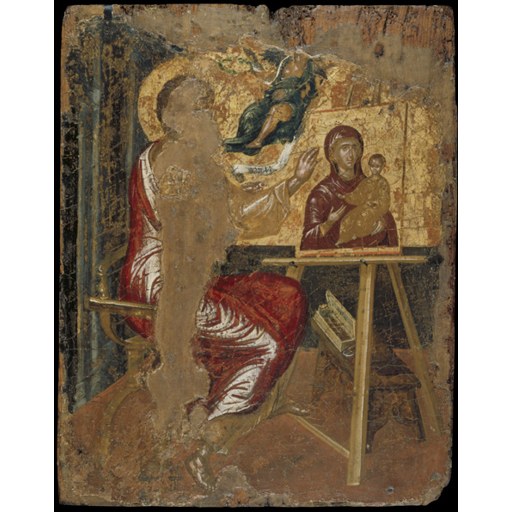
https://www.italianrenaissanceresources.com/units/unit-1/essays/saint-luke-paints-the-virgin-and-child-genealogy-of-an-image/
License: unknown
Virgin
Saint- Feast Day
- 15 August (Assumption/Dormition); 8 September (Nativity); 25 March (Annunciation); 1 January (Mary, Mother of God)
- Gender
- female
- Church
- Catholic
Roles & Family
Religious Information
Patronage
mothers;virgins;the United States;Mexico;the Americas;France;Poland;Portugal;the Philippines;Brazil;Argentina;Spain;Italy;Ireland;Hungary;mariners;travelers
Biography
The figure known in Christian tradition simply as the Virgin is Mary of Nazareth, the mother of Jesus, whose life is known principally from the New Testament Gospels rather than from independent contemporary records. According to Luke, she was a young woman of Nazareth in Galilee, betrothed to Joseph of the house of David, when the angel Gabriel announced that she would conceive a son by the Holy Spirit. Matthew likewise presents her as a virgin at the time of the conception and records that Joseph, after a dream, took her as his wife. She gave birth to Jesus in Bethlehem; Luke further describes the presentation of the child in the Temple at Jerusalem and an episode in which the twelve-year-old Jesus was found among the teachers there. The Gospels place her at the wedding at Cana, at the foot of the cross, where Jesus entrusted her to the beloved disciple, and, in Acts, among the disciples in Jerusalem at Pentecost. These passages constitute the core of what can be said from the earliest Christian sources.
Later Christian literature, especially the second-century Protoevangelium of James, supplied names for her parents (Joachim and Anne), an account of her own childhood dedicated to the Temple, and a strong emphasis on her perpetual virginity. Such extra-canonical traditions were widely received in East and West and shaped liturgy and art, but they are not historically certain. The title Theotokos (God-bearer) was affirmed at the Council of Ephesus in 431 and became central to Orthodox and Catholic veneration. Over subsequent centuries the Latin Church defined the Immaculate Conception (1854) and the Assumption (1950); the corresponding Eastern feast of the Dormition had long been celebrated on 15 August. Precise years of birth and death are unknown; traditional calculations that place her birth in the late first century BC and her death in the mid-first century AD rest on later inference, not on contemporary documentation. Competing traditions locate her last years and an empty tomb at Jerusalem or, less commonly, at Ephesus.
From late antiquity onward she has been the object of intense cult. Fixed feasts commemorate her nativity (8 September), the Annunciation (25 March), the Purification or Presentation (2 February), and the Assumption or Dormition (15 August). Apparitions attributed to her—among them Guadalupe, Lourdes, and Fatima—generated major pilgrimage centres and additional titles. She is invoked as patroness of many nations (including the United States under the Immaculate Conception, Mexico and the Americas under Our Lady of Guadalupe, France, Poland, Portugal, the Philippines, and others) as well as of mothers, virgins, mariners, and travelers. In Islam she is honored as Maryam, mother of the prophet Isa, and is the only woman named in the Qur’an, which also affirms her virginity. She was never the subject of a formal papal canonization of the later medieval or modern type; her unique status in Christian belief long preceded those procedures.