Virgin is a saint of the Catholic Church. Virgin's feast day is celebrated on January 1 (Mary, Mother of God); March 25 (Annunciation); August 15 (Assumption/Dormition); September 8 (Nativity of Mary); December 8 (Immaculate Conception). Virgin is the patron saint of the Catholic Church;mothers;virgins;consecrated women;the United States of America;France;Poland;Portugal;Spain;Mexico;the Philippines;Brazil;Italy;Bavaria;Austria;Ireland;seafarers;the sick;the dying.
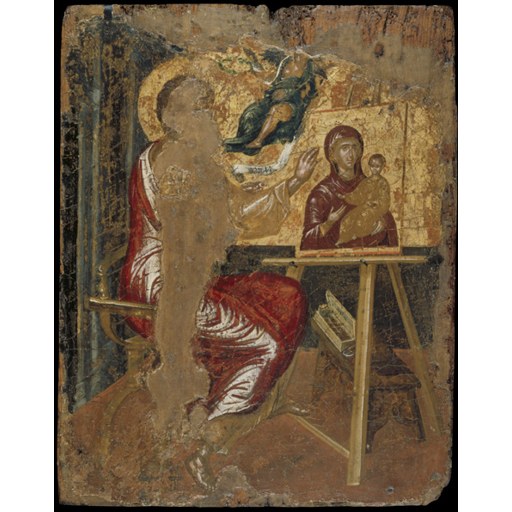
https://www.italianrenaissanceresources.com/units/unit-1/essays/saint-luke-paints-the-virgin-and-child-genealogy-of-an-image/
License: unknown
Virgin
Saint- Feast Day
- January 1 (Mary, Mother of God); March 25 (Annunciation); August 15 (Assumption/Dormition); September 8 (Nativity of Mary); December 8 (Immaculate Conception)
- Gender
- female
- Church
- Catholic
Roles & Family
Religious Information
Patronage
the Catholic Church;mothers;virgins;consecrated women;the United States of America;France;Poland;Portugal;Spain;Mexico;the Philippines;Brazil;Italy;Bavaria;Austria;Ireland;seafarers;the sick;the dying
Biography
Mary, commonly called the Blessed Virgin Mary or simply the Virgin in Christian tradition, was a first-century Jewish woman of Galilee, known from the New Testament as the mother of Jesus of Nazareth. Contemporary non-Christian sources do not independently narrate her life; nearly all that can be said of her historically rests on the canonical Gospels and the Acts of the Apostles, composed in the later first century. Matthew and Luke present her as betrothed to Joseph, a man of Davidic descent, at the time she conceived Jesus. Luke describes an annunciation by the angel Gabriel at Nazareth, in which she is told she will bear a son by the Holy Spirit and gives her consent. Matthew recounts Joseph’s intention to dismiss her quietly and his subsequent decision, after a dream, to take her as his wife. Neither Gospel states her year of birth, parentage, or exact birthplace. Later second-century apocryphal writing, especially the Protoevangelium of James, names her parents Joachim and Anne and places her early life in and around Jerusalem, but those details are not historically verifiable and should not be treated as documented fact.
In the infancy narratives she gives birth to Jesus at Bethlehem, is visited by shepherds (Luke) and Magi (Matthew), and, according to Matthew, flees with Joseph and the child to Egypt to escape Herod. Luke records her purification and the child’s presentation in the Jerusalem Temple, and an episode when Jesus, aged twelve, is found among the teachers there. In the accounts of the public ministry she appears at the wedding at Cana in John’s Gospel, where Jesus performs his first sign at her intercession, and she is named among those who seek Jesus during his Galilean work. John’s Passion narrative places her at the foot of the cross, where Jesus commends her to the beloved disciple. Acts 1:14 lists her among the disciples gathered in Jerusalem after the Ascension, around the time of Pentecost. No New Testament text records the date, place, or circumstances of her death, and no reliable extra-biblical source supplies them.
Post-biblical Christian tradition diverges on her last years. One strand, associated with Jerusalem, holds that she died (or fell asleep) there and was buried in the Kidron Valley; the site known as the Tomb of the Virgin Mary became a pilgrimage location, described as empty in the doctrine of the Assumption. Another strand, linked to the apostle John, associates her later life with Ephesus in Asia Minor. Neither tradition can be confirmed historically. From late antiquity the churches of East and West commemorated her Dormition or Assumption on 15 August. The Council of Ephesus in 431 affirmed the title Theotokos (God-bearer). Catholic dogma later defined the Immaculate Conception (Pius IX, 1854) and the Assumption (Pius XII, 1950); these definitions are not shared by all Christian communions. Eastern Orthodox, Oriental Orthodox, and many Protestant communities honor Mary as the mother of Jesus while differing on later Marian doctrines. She held no episcopal, papal, or patriarchal office, belonged to no later religious order, and was not the subject of a medieval or modern canonization or beatification process; her veneration is of early Christian origin rather than the product of the later formal saint-making procedures.
Mary is invoked as patroness of an exceptionally large number of places, peoples, and causes. National and regional patronages include, among many others, the United States (under the title of the Immaculate Conception), France, Poland, Portugal, Spain, Mexico, the Philippines, Brazil, Italy, Bavaria, Austria, and Ireland. She is widely regarded as patroness of mothers, of virgins and consecrated women, of the sick and the dying, and of seafarers. Principal feasts in the Roman calendar include 1 January (Mary, Mother of God), 25 March (Annunciation), 15 August (Assumption), 8 September (Nativity of Mary), and 8 December (Immaculate Conception), besides numerous local and titular celebrations in East and West. Because precise biographical dates cannot be established from reliable historical evidence, any claimed birth year or death year is conjectural or legendary and is omitted here.