Virgin is a saint of the Catholic Church. Virgin's feast day is celebrated on 8 September (Nativity of Mary); 1 January (Mary, Mother of God); 25 March (Annunciation); 15 August (Assumption/Dormition); 8 December (Immaculate Conception). Virgin is the patron saint of the Catholic Church;mothers;expectant mothers;virgins;families;the Americas;Mexico;Poland;Portugal;France;the Philippines;Spain;the United States;Brazil;Argentina.
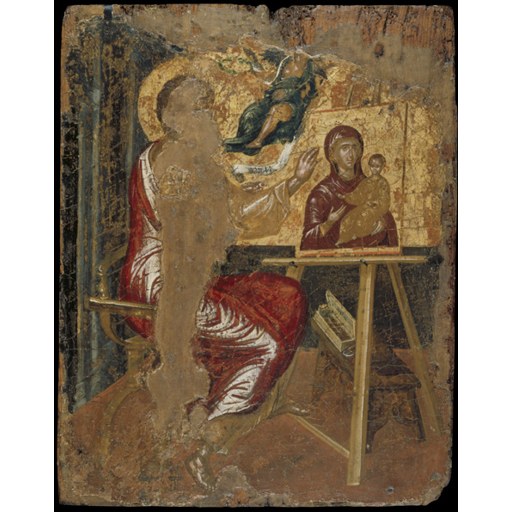
https://www.italianrenaissanceresources.com/units/unit-1/essays/saint-luke-paints-the-virgin-and-child-genealogy-of-an-image/
License: unknown
Virgin
Saint- Feast Day
- 8 September (Nativity of Mary); 1 January (Mary, Mother of God); 25 March (Annunciation); 15 August (Assumption/Dormition); 8 December (Immaculate Conception)
- Gender
- female
- Church
- Catholic
Roles & Family
Religious Information
Patronage
the Catholic Church;mothers;expectant mothers;virgins;families;the Americas;Mexico;Poland;Portugal;France;the Philippines;Spain;the United States;Brazil;Argentina
Biography
Mary, commonly called the Blessed Virgin Mary or simply the Virgin in Christian tradition, is identified in the New Testament as the mother of Jesus of Nazareth. The principal sources for her life are the Gospels of Matthew and Luke, which contain infancy narratives, together with briefer references in Mark, John, and the Acts of the Apostles. These texts present her as a Jewish woman of Galilee associated with the town of Nazareth, betrothed to Joseph, a man of Davidic descent. Precise dates of her birth and death are not recorded in contemporary historical sources, and later chronological reconstructions remain conjectural. Extra-biblical details concerning her parentage, childhood, and last years derive chiefly from second-century and later Christian writings, notably the Protoevangelium of James, which names her parents as Joachim and Anne and places aspects of her early life in Jerusalem; such accounts are valuable for the history of devotion but are not independent historical documentation of the first century.
According to Luke, the angel Gabriel announced to Mary at Nazareth that she would conceive a son by the Holy Spirit, to be named Jesus, and that her relative Elizabeth was also with child. Luke records Mary's journey to the hill country of Judah, her greeting of Elizabeth, and the Magnificat. Matthew's account focuses on Joseph's reception of the news, the birth of Jesus at Bethlehem during the reign of Herod, the visit of the magi, the flight into Egypt, and the family's eventual settlement in Nazareth. Luke further describes the presentation of Jesus in the Temple and the finding of the twelve-year-old Jesus among the teachers there. These narratives, written in the late first century, combine historical memory of Jesus's family origins with theological interpretation. Historians generally accept that Jesus's mother was named Mary and that he was known as being from Nazareth, while treating specific miraculous and chronological details according to the genre of the sources.
Mary appears only occasionally in the accounts of Jesus's public ministry. John's Gospel places her at the wedding at Cana, where she informs Jesus that the wine has run out, and at the crucifixion, where Jesus entrusts her to the beloved disciple. The Synoptic Gospels mention her among family members who seek Jesus, and Acts 1:14 lists her among those gathered in prayer in Jerusalem after the Ascension, together with the Twelve, other women, and Jesus's brothers. The New Testament is silent about her subsequent life and about the manner and place of her death. From late antiquity, two principal local traditions competed: one associating her last years and Dormition (falling asleep) with Jerusalem, where a tomb in the Kidron Valley has been venerated, and another, connected with the later tradition of John's residence, placing her at Ephesus. The doctrine of the Assumption, that she was taken body and soul into heavenly glory, was defined as a dogma of the Catholic Church in 1950 and corresponds to the ancient Eastern feast of the Dormition; it is a matter of faith and liturgical tradition rather than of recoverable historical biography.
The Council of Ephesus in 431, in the context of Christological controversy, affirmed the title Theotokos (God-bearer) for Mary, a title already established in liturgy. Subsequent centuries saw the growth of feasts, of pilgrimage sites, and of a vast body of homiletic, poetic, and artistic tradition in both Eastern and Western Christianity. She was never the object of a formal process of beatification or canonization of the kind later used for other saints, because veneration of her is attested from the earliest strata of Christian practice. Protestant traditions have generally accorded her honor as the mother of Jesus while rejecting later Marian dogmas and some forms of cult. Historical scholarship distinguishes the first-century Galilean Jewish woman who was the mother of Jesus from the richly elaborated figure of later piety, while recognizing that the latter has been of immense cultural and religious importance across two millennia.