Virgin is a saint of the Catholic Church. Virgin's feast day is celebrated on 8 September (Nativity of Mary); 15 August (Assumption/Dormition); 1 January (Mary, Mother of God); 25 March (Annunciation). Virgin is the patron saint of mothers;virgins;the Catholic Church;expectant mothers;the Americas;Mexico;Poland;the Philippines;Portugal;sailors.
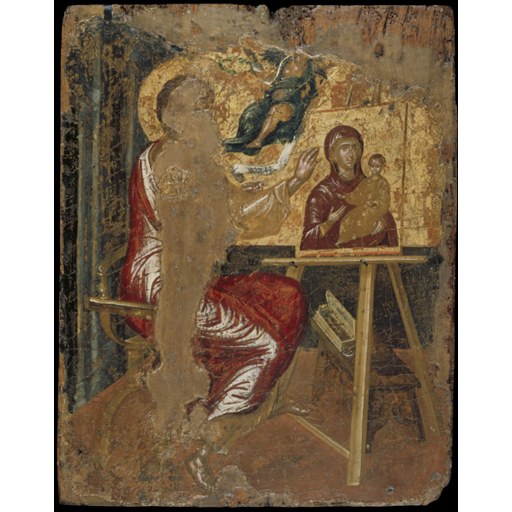
https://www.italianrenaissanceresources.com/units/unit-1/essays/saint-luke-paints-the-virgin-and-child-genealogy-of-an-image/
License: unknown
Virgin
Saint- Feast Day
- 8 September (Nativity of Mary); 15 August (Assumption/Dormition); 1 January (Mary, Mother of God); 25 March (Annunciation)
- Gender
- female
- Church
- Catholic
Roles & Family
Religious Information
Patronage
mothers;virgins;the Catholic Church;expectant mothers;the Americas;Mexico;Poland;the Philippines;Portugal;sailors
Biography
Mary of Nazareth, known in Christian tradition as the Blessed Virgin Mary, is the mother of Jesus of Nazareth. The only first-century sources that mention her are the New Testament writings. Matthew and Luke contain infancy narratives; Mark, John, and Acts of the Apostles give shorter notices. None of these texts records a year of birth or death, names her parents, or states a birthplace. Extra-biblical works, above all the second-century Protoevangelium of James, later supplied a legendary childhood, the names Joachim and Anne, and a setting in Jerusalem, but those details are not confirmed by contemporary historical evidence. Historically she can be placed as a Jewish woman of Galilee in the late Second Temple period, associated with Nazareth and with the movement around Jesus.
Luke presents her as betrothed to Joseph when she receives the annunciation that she will conceive a son by the Holy Spirit, then visiting her relative Elizabeth in the Judean hill country, and giving birth to Jesus at Bethlehem. Matthew, telling the story through Joseph, includes the magi, a threat from Herod, a sojourn in Egypt, and a return to Nazareth. The census under Quirinius and the coordination with Herod the Great (died 4 BCE) remain debated among historians; the Gospels themselves do not yield a verified calendar date for her life. What they do establish is her identity as Jesus’ mother and her marriage, in Jewish betrothal custom, to Joseph. Christian tradition from the second century onward held that she remained a virgin before, during, and after the birth of Jesus; the New Testament itself does not spell out that doctrine, and later readers have differed over the meaning of Jesus’ “brothers.” She is, in any case, documented as the mother of Jesus.
In the accounts of Jesus’ public life she appears at Cana in John’s Gospel and at the crucifixion, where Jesus commends her to the beloved disciple. Acts lists her in Jerusalem after the ascension, with the Twelve and with Jesus’ brothers. After that the New Testament is silent. Two early local traditions grew up about her last years: one kept her in Jerusalem, where a tomb in the Kidron Valley was later venerated and where the Dormition (falling asleep) was commemorated; another, tied to the apostle John, placed her at Ephesus. Neither can be verified from first-century evidence. Eastern churches long observed the Dormition on 15 August; the Catholic Church defined the Assumption as dogma in 1950. She was never canonized by a later papal process; veneration of her is apostolic in origin in the ancient churches.
Doctrinal development continued for centuries. The title Theotokos (God-bearer) was upheld at the Council of Ephesus in 431. Perpetual virginity became standard teaching in East and West. In the Latin Church the Immaculate Conception was defined in 1854. Her liturgical commemorations multiplied: 1 January (Mary, Mother of God, in the Roman calendar), 25 March (Annunciation), 15 August (Assumption or Dormition), 8 September (Nativity of Mary), and 8 December (Immaculate Conception in the Latin Church), among many local feasts. Devotion to her as intercessor and as patron of nations, mothers, and the Church is medieval and modern as well as ancient; the historical core remains the Galilean Jewish woman named in the Gospels as the mother of Jesus.