Virgin is a saint of the Catholic Church. Virgin's feast day is celebrated on 25 March (Annunciation); 15 August (Assumption/Dormition); 8 September (Nativity of Mary); 1 January (Mary, Mother of God); 8 December (Immaculate Conception). Virgin is the patron saint of mothers;virgins;people in childbirth;the United States;France;Poland;Portugal;the Philippines;Mexico;the Americas.
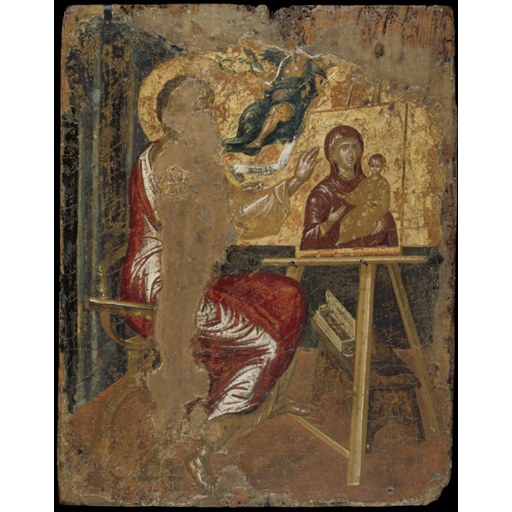
https://www.italianrenaissanceresources.com/units/unit-1/essays/saint-luke-paints-the-virgin-and-child-genealogy-of-an-image/
License: unknown
Virgin
Saint- Feast Day
- 25 March (Annunciation); 15 August (Assumption/Dormition); 8 September (Nativity of Mary); 1 January (Mary, Mother of God); 8 December (Immaculate Conception)
- Gender
- female
- Church
- Catholic
Roles & Family
Religious Information
Patronage
mothers;virgins;people in childbirth;the United States;France;Poland;Portugal;the Philippines;Mexico;the Americas
Biography
Mary, known in Christian tradition as the Blessed Virgin Mary or simply the Virgin, is identified in the New Testament as the mother of Jesus of Nazareth. The principal sources for her life are the infancy narratives in the Gospels of Matthew and Luke, together with briefer notices in the Gospel of John and the Acts of the Apostles. These texts place her in Galilee in the early first century and associate her with the village of Nazareth. They describe her as a Jewish woman betrothed to Joseph, a man of Davidic descent. The New Testament does not record a year or place of her birth or of her death. Later Christian literature, above all the second-century Protoevangelium of James, names her parents as Joachim and Anne and sets parts of her early life in Jerusalem, but those details are not independently verified and are treated by historians as later pious tradition rather than established fact.
According to Luke, the angel Gabriel announced to Mary that she would conceive a son by the Holy Spirit while she was still a virgin; she consented to that announcement. Matthew recounts Joseph’s discovery of the pregnancy, his intention to dismiss her quietly, and a dream in which he is told to take her as his wife and to name the child Jesus. Matthew states that Joseph did take her as his wife. The couple is described as going to Bethlehem, where the child was born; Matthew also reports a flight into Egypt and a later return to Nazareth. That she was the mother of Jesus is universally attested in Christian sources. Catholic, Eastern Orthodox, Oriental Orthodox, and some other traditions teach her perpetual virginity. Other Christian readings take New Testament references to the brothers and sisters of Jesus as children of Mary and Joseph. No historically verified date can be given for her birth or death, and office-taking or feast dates must not be substituted for them.
In the Gospel of John she appears at the wedding at Cana, where Jesus performs his first sign after her intervention, and at the crucifixion, where Jesus commends her to the beloved disciple. The Acts of the Apostles lists her among the disciples gathered in prayer in Jerusalem after the Ascension. From late antiquity, Christian liturgy, art, and doctrine developed an extensive cultus around her. The Council of Ephesus in 431 affirmed the title Theotokos (God-bearer). Eastern churches commemorate her Dormition; the Roman Catholic Church defined the Immaculate Conception in 1854 and the Assumption in 1950. She was never formally beatified or canonized, because public veneration of her long predates the juridical processes of canonization that emerged in the medieval Latin Church. She held no patriarchal see and was never Bishop of Rome or Coptic Pope of Alexandria, and she belonged to no later religious order.
Principal feast days in Western and Eastern calendars include the Annunciation on 25 March, the Nativity of Mary on 8 September, and 15 August, kept as the Assumption in the West and the Dormition in the East. The Roman calendar also keeps 1 January as the Solemnity of Mary, Mother of God, and 8 December as the Immaculate Conception. She is invoked as patron of mothers and of virgins, of people in childbirth, and of many nations, including France, Poland, Portugal, the Philippines, Mexico, and the United States under the title of the Immaculate Conception, as well as of the Americas more broadly. No archaeologically confirmed burial is known; a traditional tomb is shown in the Kidron Valley at Jerusalem, while another tradition associates her later years with Ephesus. Both locations remain matters of devotion rather than of verified historical record.