Virgin is a saint of the Catholic Church. Virgin's feast day is celebrated on 1 January (Mary, Mother of God); 25 March (Annunciation); 15 August (Assumption/Dormition); 8 September (Nativity of Mary); 8 December (Immaculate Conception). Virgin is the patron saint of mothers;virgins;the Catholic Church;all humanity;the Americas;Mexico;the Philippines;Poland;France;Portugal;Spain;Italy;Hungary;Ireland;sailors;travelers.
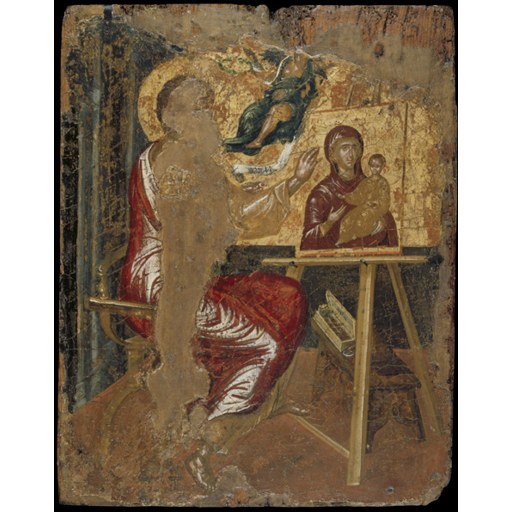
https://www.italianrenaissanceresources.com/units/unit-1/essays/saint-luke-paints-the-virgin-and-child-genealogy-of-an-image/
License: unknown
Virgin
Saint- Feast Day
- 1 January (Mary, Mother of God); 25 March (Annunciation); 15 August (Assumption/Dormition); 8 September (Nativity of Mary); 8 December (Immaculate Conception)
- Gender
- female
- Church
- Catholic
Roles & Family
Religious Information
Patronage
mothers;virgins;the Catholic Church;all humanity;the Americas;Mexico;the Philippines;Poland;France;Portugal;Spain;Italy;Hungary;Ireland;sailors;travelers
Biography
The figure known in Christian tradition simply as the Virgin is Mary, the mother of Jesus of Nazareth. The canonical Gospels portray her as a Jewish woman living in Nazareth in Galilee in the early first century, betrothed to Joseph, a man of Davidic descent. Luke’s Gospel places the Annunciation in Nazareth: the angel Gabriel announces that she will conceive a son by the Holy Spirit, to be named Jesus. Matthew’s infancy narrative is told largely from Joseph’s standpoint and includes the birth at Bethlehem and the flight into Egypt. John’s Gospel records her presence at the wedding at Cana and at the crucifixion, where Jesus commends her to the beloved disciple. Acts places her with the apostles in Jerusalem after the Ascension. The New Testament does not give a year or place of her birth or death, nor does it name her parents.
Later Christian literature, especially the second-century Protoevangelium of James, identifies her parents as Joachim and Anne and situates her early life in Jerusalem, including a presentation in the Temple. These details belong to pious tradition rather than to sources that can be verified by contemporary historical evidence. The same is true of claims that she was born in Jerusalem, Nazareth, or Sepphoris. What can be said with caution is that she was a Galilean Jewish woman of the Herodian–Roman period whose life became the starting point of Christian reflection on the Incarnation.
Christian tradition developed several doctrines concerning her that go beyond the New Testament text: perpetual virginity, her title Theotokos (God-bearer), affirmed at the Council of Ephesus in 431, the Dormition or Assumption, and, in the Latin West, the Immaculate Conception. Eastern churches commemorate her falling asleep on 15 August; the Latin church keeps the same date as the Assumption. Her nativity is kept on 8 September. Tradition is divided on the place of her death, with Jerusalem and Ephesus both claimed; a tomb in the Kidron Valley at Jerusalem has long been venerated, though the doctrine of the Assumption holds that her body did not remain in the grave. She held no ecclesiastical office and belonged to no religious order. Gospel references to the “brothers” of Jesus have been interpreted in various ways: as cousins, as children of Joseph by a previous marriage, or, in some later Protestant readings, as further children of Mary. Catholic and Orthodox hagiography has consistently taught that Jesus was her only child and that she remained a virgin.
Veneration of Mary is apostolic in origin and was never the result of a later formal canonization process. She is invoked under countless titles and as patroness of nations, dioceses, religious families, mothers, virgins, sailors, and the sick, among many other causes. Major liturgical commemorations include 1 January (Mary, Mother of God, in the Roman calendar), 25 March (Annunciation), 15 August, 8 September, and 8 December (Immaculate Conception in the Roman calendar; the Conception of the Theotokos is kept on 9 December in some Eastern calendars). Historical reconstruction of her biography remains severely limited by the nature of the sources; the Gospels and the earliest church remember her as the mother of Jesus and as a disciple present at the origins of the Christian community, while later centuries elaborated her cult, her titles, and the cycle of her feasts.