Virgin is a saint of the Catholic Church. Virgin's feast day is celebrated on 15 August (Assumption/Dormition); 8 September (Nativity of Mary); 8 December (Immaculate Conception); 1 January (Solemnity of Mary, Mother of God); 25 March (Annunciation); 31 May (Visitation). Virgin is the patron saint of mothers;virgins;the Catholic Church;families;the Americas;Mexico;France;Poland;Portugal;the Philippines;the United States;sailors;the sick;converts.
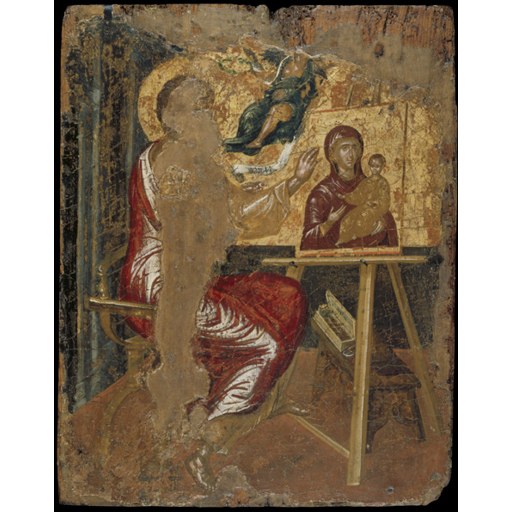
https://www.italianrenaissanceresources.com/units/unit-1/essays/saint-luke-paints-the-virgin-and-child-genealogy-of-an-image/
License: unknown
Virgin
Saint- Feast Day
- 15 August (Assumption/Dormition); 8 September (Nativity of Mary); 8 December (Immaculate Conception); 1 January (Solemnity of Mary, Mother of God); 25 March (Annunciation); 31 May (Visitation)
- Gender
- female
- Church
- Catholic
Roles & Family
Religious Information
Patronage
mothers;virgins;the Catholic Church;families;the Americas;Mexico;France;Poland;Portugal;the Philippines;the United States;sailors;the sick;converts
Biography
The figure known in Christian tradition as the Virgin Mary (also Mary of Nazareth, the Blessed Virgin Mary, or simply the Virgin) is the mother of Jesus of Nazareth according to the New Testament. Almost nothing about her life can be established by independent contemporary historical documentation outside the Christian scriptures and later ecclesiastical tradition. The principal narrative sources are the Gospels of Matthew and Luke, which contain infancy narratives composed in the late first century, together with briefer references in Mark, John, and the Acts of the Apostles. These texts present her as a Jewish woman of Galilee, living in the town of Nazareth, betrothed to a man named Joseph of the house of David, during the reign of Herod the Great and the Roman administration of Judea and Galilee in the early first century. No historically verified year of birth or death survives; traditional calculations that place her birth in the late first century BC are inferences from the chronology of Jesus, not independent records.
According to Luke, an angel announced to her that she would conceive a son by the Holy Spirit; she consented in the scene of the Annunciation. Matthew's account focuses on Joseph's reception of the same news in a dream and on the couple's sojourn in Bethlehem, flight into Egypt, and return to Nazareth. The canonical Gospels do not record her parentage; later apocryphal works, especially the second-century Protoevangelium of James, name her parents Joachim and Anne and place her early life in Jerusalem, but these details are legendary rather than historically verified. She appears at the wedding at Cana in John's Gospel, at the foot of the cross where Jesus commends her to the beloved disciple, and among the disciples in Jerusalem after the Ascension (Acts 1:14). The New Testament is silent on the date, place, and circumstances of her death. That she was the mother of Jesus is the one biographical fact affirmed across all major Christian sources; whether she had other children is disputed, because New Testament references to the brothers of Jesus have been read as cousins, as children of Joseph by a prior marriage, or as later offspring of Mary and Joseph.
Christian tradition developed two principal accounts of her passing: a death and burial at Jerusalem, associated with the Tomb of the Virgin in the Kidron Valley, and a residence and dormition at Ephesus, linked in later centuries to a house venerated near that city. Neither tradition can be confirmed by contemporary evidence. The doctrines of the Dormition (in Eastern Christianity) and the Assumption (defined as Catholic dogma in 1950) hold that she was taken into heaven at the end of her earthly life; these are matters of faith rather than of recoverable historical fact. From late antiquity she was honored as Theotokos (God-bearer), a title confirmed at the Council of Ephesus in 431. Perpetual virginity—before, during, and after the birth of Jesus—became standard teaching in both East and West. She was never the subject of a formal papal canonization of the later medieval or modern type; her cult is apostolic and patristic in origin.
Veneration of Mary as virgin and mother is among the oldest continuous cults in Christianity, expressed in liturgy, art, pilgrimage, and an extensive calendar of feasts. Major commemorations include the Annunciation (25 March), the Nativity of Mary (8 September), the Assumption or Dormition (15 August), and, in the Latin Church, the Immaculate Conception (8 December) and the Solemnity of Mary, Mother of God (1 January). She is invoked as patroness of countless places, nations, religious congregations, and causes; no single list can be exhaustive. Historians can affirm only a modest core: that Jesus had a mother named Mary, that she was associated with Nazareth in Galilee in the early first century, and that she became, within a few generations of his death, the object of unique honor in the communities that remembered him.