Virgin is a saint of the Catholic Church. Virgin's feast day is celebrated on 15 August (Assumption/Dormition); 1 January (Mary, Mother of God); 25 March (Annunciation); 8 September (Nativity of Mary); 8 December (Immaculate Conception). Virgin is the patron saint of mothers;virgins;the Americas;Mexico;the Philippines;Poland;France;Portugal;Brazil;Spain;the United States;Hungary;Ireland;Lithuania;Malta;Australia;sailors (Stella Maris);the Catholic Church.
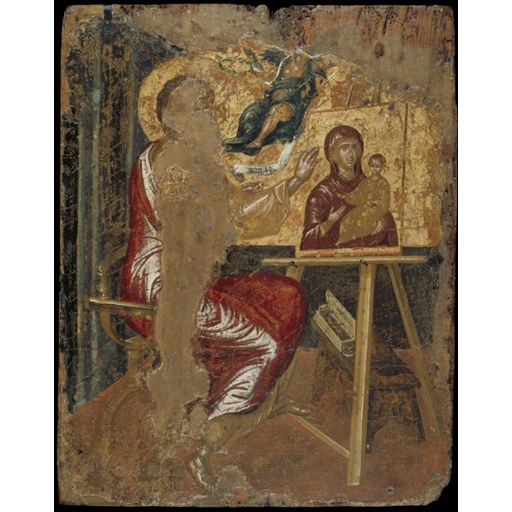
https://www.italianrenaissanceresources.com/units/unit-1/essays/saint-luke-paints-the-virgin-and-child-genealogy-of-an-image/
License: unknown
Virgin
Saint- Feast Day
- 15 August (Assumption/Dormition); 1 January (Mary, Mother of God); 25 March (Annunciation); 8 September (Nativity of Mary); 8 December (Immaculate Conception)
- Gender
- female
- Church
- Catholic
Roles & Family
Religious Information
Patronage
mothers;virgins;the Americas;Mexico;the Philippines;Poland;France;Portugal;Brazil;Spain;the United States;Hungary;Ireland;Lithuania;Malta;Australia;sailors (Stella Maris);the Catholic Church
Biography
In Christian hagiography the unqualified title ‘the Virgin’ almost invariably denotes Mary, the mother of Jesus of Nazareth. The only sources that can be treated as near-contemporary are the New Testament: the infancy narratives of Matthew and Luke, scattered notices in Mark and John, and a brief mention in Acts. These present her as a Jewish woman of Galilee in the early first century, living at Nazareth and betrothed or married to Joseph, a man of Davidic descent. No extra-biblical document from her lifetime survives. Precise years of birth and death are not recorded anywhere in the canonical texts, and later calculations that assign her a birth in the late first century BC are reconstructions, not verified data. The Gospels likewise do not name her birthplace; Nazareth is the setting of the Annunciation, not a documented place of birth.
Luke describes the Annunciation at Nazareth, Mary’s visit to her relative Elizabeth in the hill country of Judah, the birth of Jesus at Bethlehem during the reign of Herod the Great, the presentation in the Jerusalem Temple, and an incident when Jesus, then about twelve, remained behind in Jerusalem. Matthew adds Joseph’s role, the visit of the magi, and a flight into Egypt. John places Mary at the wedding at Cana and at the crucifixion, where Jesus commends her to the beloved disciple. Acts lists her among those at prayer in Jerusalem after the ascension. These are the only episodes that rest on first-century Christian writing. She is not described as holding any ecclesiastical office, nor as belonging to a religious order in the later monastic sense.
From the second century a much fuller legendary life grew up, especially in the Protoevangelium of James, which names her parents Joachim and Anne, places her childhood at the Temple, and insists on her virginity before and after the birth of Jesus. The title Theotokos (God-bearer) was defined at the Council of Ephesus in 431. Eastern churches commemorate her Dormition, Western churches her Assumption (dogmatically defined in 1950, but celebrated many centuries earlier). Traditional sites associated with her death or burial include the Tomb of the Virgin in the Kidron Valley at Jerusalem and a house at Ephesus; neither identification is confirmed by contemporary evidence, and both Catholic and Orthodox doctrine hold that her body was not left in the tomb. Veneration of Mary as Virgin is already visible in third-century prayer (the Sub tuum praesidium) and in Roman catacomb art.
Whether she had children besides Jesus is interpreted differently across Christian traditions. The Catholic and Orthodox churches teach perpetual virginity and read the ‘brothers’ of Jesus in the Gospels as kinsmen or as children of Joseph by an earlier marriage. Many Protestant interpreters take those references as biological siblings. That she was the mother of Jesus is not in dispute in any major Christian tradition, and the Gospels present her as Joseph’s wife. She was never formally canonized or beatified by a later pope; her cult is apostolic and patristic rather than the product of a medieval or modern canonization process. Countless later saints are themselves styled ‘virgin’ or ‘virgin-martyr’; without a personal name, however, the hagiographical subject ‘Virgin’ is Mary.