Virgin is a saint of the Catholic Church. Virgin's feast day is celebrated on 15 August (Assumption/Dormition); 8 September (Nativity); 25 March (Annunciation); 1 January (Mary, Mother of God). Virgin is the patron saint of mothers;virgins;sailors;the Americas;the United States;Mexico;Poland;Portugal;France;the Philippines;Brazil.
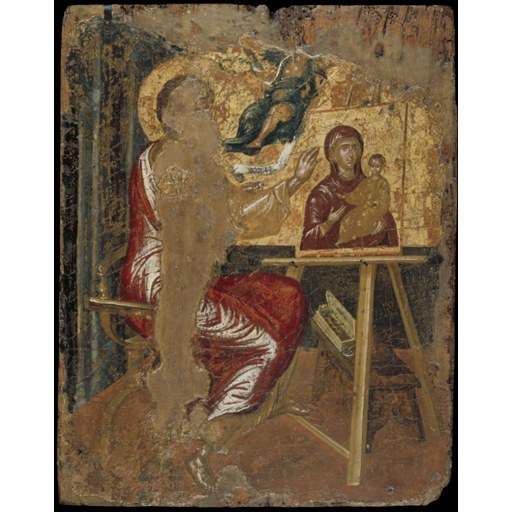
https://www.italianrenaissanceresources.com/units/unit-1/essays/saint-luke-paints-the-virgin-and-child-genealogy-of-an-image/
License: unknown
Virgin
Saint- Feast Day
- 15 August (Assumption/Dormition); 8 September (Nativity); 25 March (Annunciation); 1 January (Mary, Mother of God)
- Gender
- female
- Church
- Catholic
Roles & Family
Religious Information
Patronage
mothers;virgins;sailors;the Americas;the United States;Mexico;Poland;Portugal;France;the Philippines;Brazil
Biography
Mary, commonly called the Blessed Virgin Mary in Christian usage, was a Jewish woman of first-century Galilee, known from the New Testament as the mother of Jesus of Nazareth. The Gospels of Matthew and Luke describe her as living in Nazareth and betrothed to Joseph, a man of Davidic descent. Luke recounts that the angel Gabriel announced she would conceive a son by the Holy Spirit; Matthew likewise presents the conception as virginal and Joseph as taking her as his wife. Later New Testament passages place her at the wedding at Cana, at the crucifixion of Jesus, and among the disciples in Jerusalem after the Ascension. These texts are the principal ancient sources for her life; they are theological narratives rather than biographies in the modern sense, and they supply no year of birth or death.
Outside the canonical Gospels, almost nothing about her origins can be confirmed from independent historical evidence. The second-century Protoevangelium of James names her parents Joachim and Anne, places her birth in Jerusalem, and describes a childhood dedicated in the Temple, but that work is generally regarded as legendary rather than documentary. Traditions locating her later life in Jerusalem or at Ephesus likewise rest on late and conflicting testimony. Modern historians therefore treat her as a real first-century Galilean Jewish woman whose precise dates, parentage, and place of birth remain unknown.
Christian reflection on Mary developed rapidly. By the late fourth and fifth centuries she was widely honored as Theotokos, a title affirmed at the Council of Ephesus in 431. Belief that she remained a virgin before, during, and after the birth of Jesus became standard in both Eastern and Western churches, though the New Testament references to brothers of Jesus have been interpreted differently in various Christian traditions. She held no ecclesiastical office, belonged to no later religious order, and was never subject to the medieval or modern processes of beatification and canonization; public veneration of her is attested from late antiquity onward and became one of the most extensive cults in Christianity.
Traditions concerning the end of her earthly life diverge. Eastern churches commemorate her Dormition, generally holding that she died and was then assumed into heaven. The Catholic Church defined the Assumption as a dogma in 1950 without declaring whether she died. A tomb in the Kidron Valley near Jerusalem and a house near Ephesus are among sites associated with her last years; neither association can be verified archaeologically as her burial or residence. Principal liturgical commemorations include her nativity (8 September), the Annunciation (25 March), the Assumption or Dormition (15 August), and, in the Roman calendar, the Solemnity of Mary, Mother of God (1 January).
She is invoked as patroness of numerous nations, dioceses, and causes, among them mothers, virgins, sailors, the Americas, and many individual countries including Mexico, Poland, Portugal, France, the Philippines, Brazil, and the United States. Devotional titles and apparition cults (such as Guadalupe, Lourdes, and Fatima) multiplied in the medieval and modern periods; these belong to the history of piety rather than to the recoverable biography of the first-century woman of Nazareth.