Virgin Austreberta is a saint of the Catholic Church (d. 704). Virgin Austreberta's feast day is celebrated on 10 February.
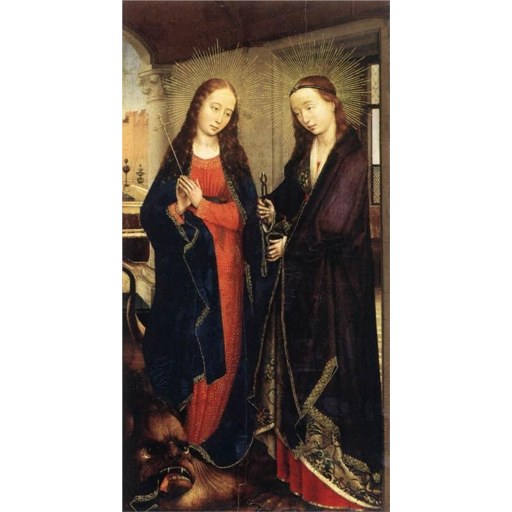
https://www.pinterest.com/shanasmith89/female-saints/
License: unknown
Virgin Austreberta
Saint- Life Span
- d. 704
- Feast Day
- 10 February
- Gender
- female
- Church
- Catholic
Places
Roles & Family
Religious Information
Canonization
Biography
Saint Austreberta, also known as Austrebertha or Austreberthe, was a Frankish virgin and abbess of the seventh century, venerated in the Catholic Church. She was born in Thérouanne, in the region of Artois in northern Gaul, into a noble family of the Merovingian aristocracy. Her father was named Badefrid (also given as Badofrid or Badefridus) and her mother Framechildis (Framehilde), who is herself honoured as a saint in certain local traditions. Precise contemporary documentation of her early life is lacking, as is typical for Merovingian-era figures; later hagiographical vitae supply the details that have come down in the tradition. She is said to have been educated at a monastic school, commonly identified as the convent of Port-le-Grand in Ponthieu.
From youth Austreberta desired the consecrated life. Hagiographical accounts relate that her family intended her for marriage, in keeping with her rank, but that she resisted. One legendary episode states that her face was miraculously altered or afflicted so that suitors would withdraw, after which her appearance was restored when she received the religious veil. She is said to have been veiled by Saint Omer (Audomarus), bishop of Thérouanne, a leading figure in the evangelization of the Morini. She subsequently became associated with the monastery of Pavilly in the Pays de Caux in Normandy, a foundation linked to Saint Philibert of Jumièges. There she served as abbess, directing a community of nuns according to the monastic customs of the Frankish church, which in that period often combined Columbanian and Benedictine elements.
Medieval lives of the saint attribute several miracles to her abbacy. The best-known story tells that a wolf killed the ass used by the nuns to fetch supplies; Austreberta then ordered the wolf to bear the panniers in the animal’s place, and the wolf obeyed. Other traditions speak of a fountain or spring associated with her, and of healings obtained through her intercession. Such narratives belong to the conventional repertoire of early medieval hagiography and cannot be independently verified; they illustrate how later generations remembered her as a wonder-working abbess and protector of her community.
Austreberta died at Pavilly, according to tradition on 10 February in the early eighth century, the year 704 being the date given in standard hagiographical compilations such as Butler and the Catholic Encyclopedia. She was buried at her monastery. A local cult developed in Normandy and in her native Artois. Her feast is observed on 10 February. The abbey of Pavilly later suffered destruction, including during the Viking incursions and again at the French Revolution, and the history of her relics is therefore fragmentary. She remains a representative figure of female monastic leadership in seventh-century Neustria, known primarily through liturgical commemoration and later medieval legend rather than through contemporary archival records.