Virgin Catherine of Siena is a saint of the Catholic Church (1347 - 1380). Virgin Catherine of Siena's feast day is celebrated on 29 April. Virgin Catherine of Siena is the patron saint of Italy;Europe;Siena;nurses;against fire;fire prevention;illness;sick people;miscarriages;people ridiculed for their piety;against sexual temptation;theologians.
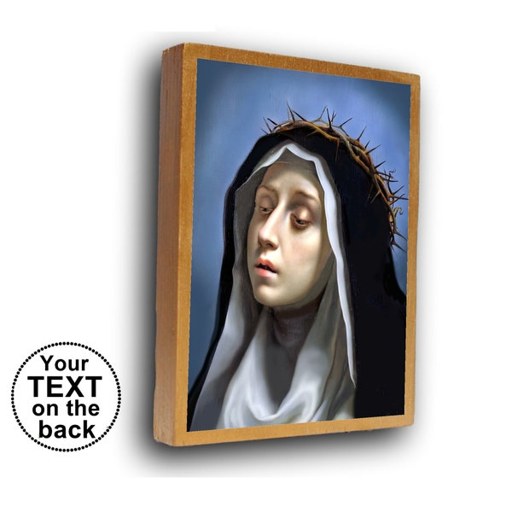
https://www.etsy.com/market/st_catherine_siena_icon
License: unknown
Virgin Catherine of Siena
Saint- Life Span
- 1347 - 1380 (age 33)
- Feast Day
- 29 April
- Gender
- female
- Church
- Catholic
Places
Roles & Family
Religious Information
Patronage
Italy;Europe;Siena;nurses;against fire;fire prevention;illness;sick people;miscarriages;people ridiculed for their piety;against sexual temptation;theologians
Canonization
Biography
Catherine of Siena was born Caterina di Jacopo di Benincasa in 1347 in Siena, then an independent Tuscan republic. She was the daughter of the wool dyer Jacopo di Benincasa and Lapa di Puccio di Piagente. Contemporary and near-contemporary accounts, above all the biography by her confessor Raymond of Capua, present her as one of a very large family and as the twin of a sister who died in infancy. In childhood she reported a vision of Christ in glory with the apostles Peter, Paul, and John, after which she resolved upon a consecrated life. When her family pressed her toward marriage she cut off her hair and adopted a life of prayer, fasting, and seclusion in the family house near the fountain of Fontebranda. She later received the black-and-white habit of the Sisters of Penance of St. Dominic, the Dominican tertiaries known in Siena as the Mantellate. She remained a laywoman, not a cloistered nun, combining domestic enclosure with service to the sick and poor of the city.
From the later 1360s she was known as a mystic and spiritual director. She described a mystical marriage to Christ, an exchange of hearts, and the reception of the stigmata at Pisa in 1375, wounds she said remained invisible during her lifetime. Her fasting was extreme; later writers have discussed it under the heading of holy anorexia, and she came to take little nourishment besides the Eucharist. Though not trained as a scholastic, she dictated a large body of letters and a vernacular theological work, The Dialogue (also called The Book of Divine Providence), composed around 1377–1378 as a conversation between the soul and God on divine love, the reform of the Church, and the spiritual life. Raymond of Capua, who became her confessor and later Master General of the Dominicans, was the principal recorder of her inner life and the author of the Legenda maior on which later hagiography depends.
Catherine also entered the public crises of the fourteenth-century Church. She urged Pope Gregory XI to leave Avignon and restore the papal residence to Rome, a return he carried out in 1377; she herself traveled to Avignon in 1376 in connection with that effort and with attempts to reconcile Florence and the papacy during the War of the Eight Saints. After Gregory’s death and the disputed election of Urban VI, she supported Urban against the Avignon claimant Clement VII, went to Rome in 1378, and remained there as an advocate of unity and of moral reform among clergy and laity. Her letters to popes, cardinals, and Italian rulers mixed spiritual exhortation with concrete political counsel. In her own understanding, peacemaking among the Italian communes and the return and reform of the papacy were inseparable from the conversion of the Church.
She died in Rome on 29 April 1380, about thirty-three years of age, after a final period of collapse and inability to take food. She was first buried at Santa Maria sopra Minerva; her body was later enshrined in that basilica, while her head was translated to the Basilica of San Domenico in Siena. Pope Pius II canonized her in 1461. In 1939 Pope Pius XII named her, together with Francis of Assisi, a principal patron of Italy. Pope Paul VI declared her a Doctor of the Church in 1970, and Pope John Paul II named her a co-patron of Europe in 1999. Her feast is kept on 29 April in the General Roman Calendar.