Virgin Germaine Cousin is a saint of the Catholic Church (1579 - 1601). Virgin Germaine Cousin's feast day is celebrated on 15 June. Virgin Germaine Cousin is the patron saint of abandoned people;abuse victims;disabled people;girls from rural areas;illness;impoverishment;loss of parents;Pibrac;shepherdesses;sick people;unattractive people;victims of child abuse;young country girls.
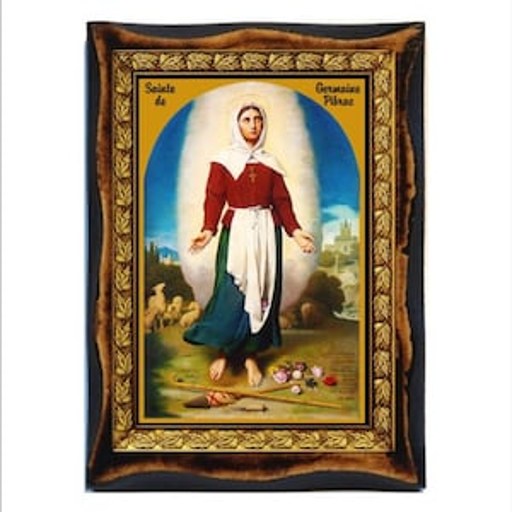
https://www.etsy.com/market/saint_germaine_cousin
License: unknown
Virgin Germaine Cousin
Saint- Life Span
- 1579 - 1601 (age 22)
- Feast Day
- 15 June
- Gender
- female
- Church
- Catholic
Places
Roles & Family
Patronage
abandoned people;abuse victims;disabled people;girls from rural areas;illness;impoverishment;loss of parents;Pibrac;shepherdesses;sick people;unattractive people;victims of child abuse;young country girls
Canonization
Biography
Germaine Cousin was born in 1579 in Pibrac, a small village about ten miles from Toulouse in southern France, into a poor rural family. Her father, Laurent Cousin, was a farm laborer. She was born with a congenital deformity of the right hand, which was paralyzed and withered, and she suffered from scrofula, a tuberculous infection of the lymph nodes that produced swellings and sores on her neck. Her mother died while Germaine was still an infant. Laurent Cousin remarried, and the stepmother who entered the household treated the child with severe cruelty. Accounts of her life describe Germaine as being kept from the family table, given little food, beaten, and made to sleep in a stable or under the stairs, isolated from her step-siblings because the stepmother feared contagion and regarded the girl as a disgrace.
From an early age Germaine was put to work as a shepherdess, watching the family's flock in the fields around Pibrac. She received no formal education and remained illiterate, yet she developed a reputation for intense religious devotion. She made a practice of attending daily Mass in the village church, leaving her sheep in the pasture. Later hagiographical tradition held that the flock never wandered and was never attacked by wolves during her absences, and that on at least one occasion she crossed a flooded stream on her way to church without being hindered. She was known to share the little bread she was given with beggars and other poor people. A frequently repeated story tells that when her stepmother accused her of stealing bread to give away and forced her to open her apron, flowers fell out instead of bread. Neighbors who had previously shunned her because of her appearance and disease gradually came to regard her as a person of unusual holiness. She lived as a laywoman and never joined a religious congregation.
In 1601, at about the age of twenty-two, Germaine died alone. She was discovered one morning lying dead on the straw pallet that served as her bed. She was buried in the parish church of Pibrac. More than forty years later, in 1644, workmen opening a nearby grave accidentally uncovered her burial place and found the body incorrupt. The discovery, together with reports of favors obtained through her intercession, gave rise to a popular cult. Pilgrims came to Pibrac, and a number of miraculous cures were recorded. The remains were placed in a more honorable shrine within the church. During the French Revolution, in 1793, anti-clerical militants desecrated the tomb, throwing the body on the floor and covering it with quicklime and water in an attempt to destroy it. Despite this, portions of the relics were preserved and were later restored to veneration.
Formal ecclesiastical recognition of her sanctity came in the nineteenth century. After examination of her life and of miracles attributed to her, Pope Pius IX beatified Germaine Cousin on 7 May 1854 and canonized her on 29 June 1867. Her feast day in the Catholic Church is 15 June. She is invoked as patron of abandoned children, victims of abuse and neglect, people with physical disabilities, shepherdesses, the sick, and rural girls, among other causes. Pibrac remains a pilgrimage site, and a basilica dedicated to her stands in the village. In Catholic tradition her life has been presented as an example of patience under suffering, charity toward the poor, and hidden holiness among the lowly.