Virgin Gertrude is a saint of the Catholic Church (1256 - 1302). Virgin Gertrude's feast day is celebrated on 16 November. Virgin Gertrude is the patron saint of West Indies;Naples;nuns;souls in purgatory.
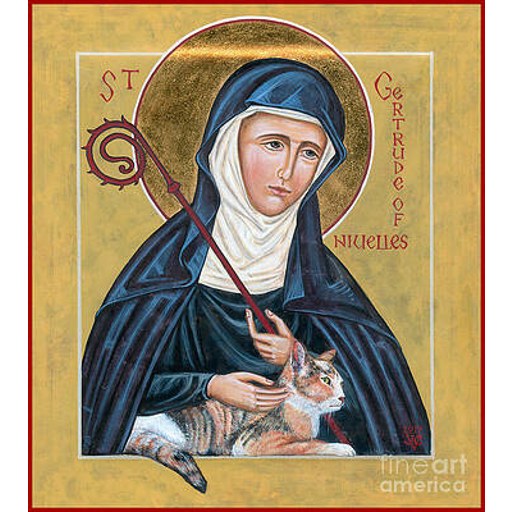
https://fineartamerica.com/art/paintings/saint+gertrude
License: unknown
Virgin Gertrude
Saint- Life Span
- 1256 - 1302 (age 46)
- Feast Day
- 16 November
- Gender
- female
- Church
- Catholic
Places
Roles & Family
Religious Information
Patronage
West Indies;Naples;nuns;souls in purgatory
Canonization
Biography
Saint Gertrude the Great, also known as Gertrude of Helfta, was a Benedictine nun and mystic of thirteenth-century Saxony. She was born on 6 January 1256; neither her family name nor her place of birth is recorded in surviving sources. At the age of five she was placed as an oblate in the monastery of Helfta, near Eisleben, a house of Benedictine nuns that followed Cistercian observances and was then one of the most intellectually and spiritually distinguished women's communities in the German lands. The abbess at the time of her entry and for many years thereafter was Gertrude of Hackeborn, a different woman with whom Gertrude the Great is often confused. At Helfta she received a rigorous education in Latin, the liberal arts, Sacred Scripture, and the Fathers of the Church, and she became known for her learning before she became known for her sanctity.
According to her own later account, she lived for a time as a capable but relatively worldly religious until, in 1281, she underwent a sudden conversion during a vision of Christ. From that point she oriented her life toward contemplative prayer, the liturgy, and theological study. She reported numerous subsequent revelations, many of them centered on the humanity of Christ and on his Heart as a symbol of divine love. These experiences, together with her liturgical piety, made her an important early witness to devotion to the Sacred Heart, though in a medieval monastic form distinct from the later revelations associated with Margaret Mary Alacoque. Gertrude did not serve as abbess; she remained a choir nun, and her authority in the community was spiritual and intellectual rather than governmental.
Her principal writings are the Herald of Divine Love (Legatus divinae pietatis) and the Spiritual Exercises (Exercitia spiritualia). Of the Herald, Gertrude herself composed the second book, a relatively personal record of her conversion and inner life; the remaining books were compiled by one or more sisters of Helfta from Gertrude's reports and from their own observations. The Spiritual Exercises consist of seven meditations structured around the liturgy and the course of a Christian life, from baptismal rebirth to preparation for death. Written in Latin, these works combine affective mysticism with a strong emphasis on the Church's public prayer, on confidence in God's mercy, and on intercession for the living and the dead. They circulated in manuscript and later in print and influenced later Catholic spirituality, especially in the early modern period.
Gertrude died at Helfta on 17 November in 1301 or 1302. The monastery was later dissolved and physically destroyed in the upheavals of the sixteenth century, and the fate of her bodily remains is not securely documented. She was not the subject of a formal canonization process of the later Roman type. Her liturgical cult developed in the later Middle Ages and was given official standing when Pope Innocent XI placed her name in the Roman Martyrology in 1677; Pope Clement XII extended her feast to the universal Church in 1738. In the General Roman Calendar she is commemorated on 16 November. She is honored as a patron of the West Indies and of Naples and is invoked on behalf of the souls in purgatory. Historians regard her as one of the major women authors of high-medieval Latin mysticism and as a central figure in the Helfta school, alongside Mechthild of Hackeborn and, for a time, Mechthild of Magdeburg.