Virgin Hyacinth is a saint of the Catholic Church (1585 - 1640). Virgin Hyacinth's feast day is celebrated on 30 January.
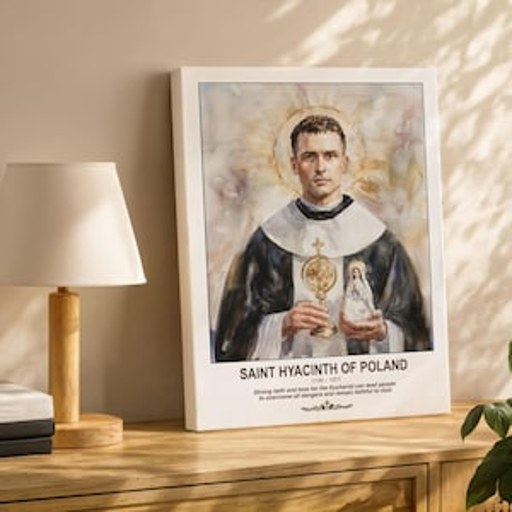
https://etsy.com/market/saint_hyacinth
License: unknown
Virgin Hyacinth
Saint- Life Span
- 1585 - 1640 (age 55)
- Feast Day
- 30 January
- Gender
- female
- Church
- Catholic
Places
Roles & Family
Religious Information
Canonization
Biography
Saint Hyacintha of Mariscotti (born Clarice Marescotti) was a noblewoman of the Papal States who became a Franciscan tertiary renowned for a late and radical conversion from vanity to austerity and charity. She was born in 1585 at Vignanello, near Viterbo, to Count Marcantonio Marescotti and Countess Ottavia Orsini. Contemporary accounts describe her youth as marked by beauty, social ambition, and a love of luxury. A hoped-for marriage into the Roman aristocracy failed when a suitor preferred her sister; thereafter, around the age of twenty, she entered the convent of Franciscan tertiaries of St. Bernardine in Viterbo, taking the religious name Hyacintha. The entrance was arranged as a respectable settlement rather than a wholehearted vocation. For about ten years she lived inside the enclosure much as she had in the world, occupying private rooms, keeping servants, wearing fine clothes, and receiving visitors.
A serious illness in adulthood, together with the reproaches of her confessor, brought about a decisive change. She dismissed her attendants, stripped her apartment of comforts, and adopted a life of severe penance: a patched habit, fasting, night vigils, and hard bedding. She turned her energy to prayer before the Blessed Sacrament and to practical relief of the poor of Viterbo. She organized groups of pious women, often called Oblates of Mary or similar names in the sources, to collect alms and to care for the sick, the aged, and prisoners. During epidemic sickness in the region she worked among the afflicted. She was also credited with reconciling quarrels and with influencing conversions, including among people of rank, while remaining, according to her biographers, insistent that any good was God’s work rather than her own.
Hyacintha died in the same Viterbo convent on 30 January 1640. A local cult developed soon afterward. She was beatified by Pope Benedict XIII in 1726 and canonized by Pope Pius VII in 1807. Her feast is observed on 30 January. In Catholic hagiography she is remembered less as a founder of a great order than as an example of conversion within the Franciscan Third Order: a woman who spent years in worldly display even after taking the habit, then spent her remaining life in poverty, penance, and organized charity. Precise day-to-day details of her inner life depend on later vitae and should be treated with the caution due to seventeenth- and eighteenth-century spiritual biography, but the outline of birth at Vignanello, long residence at the tertiary convent in Viterbo, conversion after illness, works of mercy, and death in 1640 is consistent across standard historical notices.