Virgin Katherine is a saint of the Catholic Church. Virgin Katherine's feast day is celebrated on 25 November. Virgin Katherine is the patron saint of philosophers;theologians;students;teachers;librarians;scholars;apologists;unmarried women;maidens;wheelwrights;millers;potters;lawyers;preachers;the dying;the University of Paris;Alexandria.
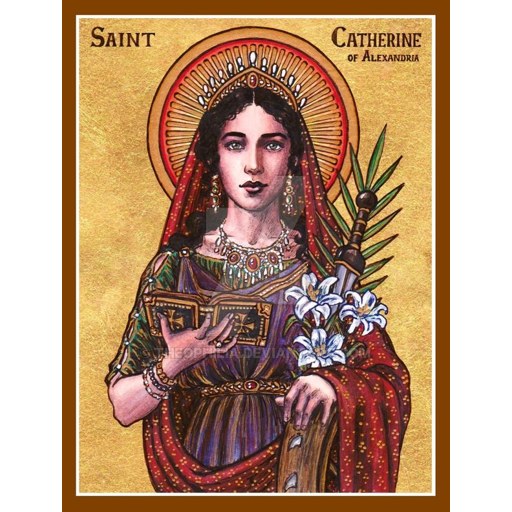
https://pinterest.com/tudorqueen6/catherine-of-alexandria
License: unknown
Virgin Katherine
Saint- Feast Day
- 25 November
- Gender
- female
- Church
- Catholic
Places
Roles & Family
Patronage
philosophers;theologians;students;teachers;librarians;scholars;apologists;unmarried women;maidens;wheelwrights;millers;potters;lawyers;preachers;the dying;the University of Paris;Alexandria
Biography
Saint Catherine of Alexandria, often called the Virgin Katherine or, in Eastern usage, the Great Martyr Catherine, is among the most widely venerated virgin martyrs of medieval Christendom, although no contemporary historical source confirms that she existed. The earliest Greek accounts of her life appear only in the eighth and ninth centuries, centuries after the period of Roman persecution in which the legend places her. According to the passio that later circulated in Latin and in many vernaculars, she was of noble or royal birth in Alexandria in Egypt and received an unusually thorough education in philosophy and the liberal arts. Converted to Christianity, she is said to have publicly challenged the emperor—commonly identified in the tradition as Maxentius—when he ordered pagan sacrifices, and to have defeated in debate a panel of fifty philosophers summoned against her. Those philosophers, converted by her arguments, were executed. Catherine refused the emperor’s offer of marriage, declaring herself the bride of Christ, and so remained a virgin.
The legend continues that she was imprisoned, miraculously sustained, and that she converted the empress and a captain of the guard who visited her. Condemned to be broken on a spiked wheel, she was spared when the machine shattered; she was then beheaded. Angels, the story relates, carried her body to Mount Sinai, where the monastery later dedicated to her claimed her relics. The debate with the philosophers, the broken wheel, and the angelic translation became the standard liturgical and iconographic marks of her cult.
Modern historians treat the vita as largely legendary. No fourth-century witness mentions a martyr Catherine at Alexandria, and the association with Maxentius is geographically and politically implausible, since he ruled in the West rather than in Egypt. Some scholars have suggested possible conflation with the pagan philosopher Hypatia of Alexandria, murdered in 415, or with other unnamed martyrs; others regard the narrative as a literary construction that acquired authority through liturgy and preaching. Despite these doubts, her cult became one of the most popular in both East and West. She was numbered among the Fourteen Holy Helpers in German-speaking lands, was a frequent patron of royal and noble women, and gave her name to churches, colleges, and craft guilds. In the Latin West her feast was kept on 25 November; Byzantine calendars observe 24 or 25 November. She long stood in the Roman Martyrology; the 1969 calendar reform reduced her commemoration to an optional memorial because of the historical uncertainties, a decision later eased in some local calendars.
Her patronages follow the learned and virginal features of the legend. Philosophers, theologians, students, teachers, librarians, and academic bodies such as the University of Paris invoke her, as do unmarried women and girls and crafts tied to the wheel—wheelwrights, millers, and potters. In art she is shown crowned, with a book, a sword or palm, and a broken spiked wheel, sometimes standing over the defeated emperor. Middle English produced a substantial Katherine Group of texts in her honour, and her story was retold in the Golden Legend, in drama, and in sermons. Whether or not a historical Alexandrian virgin of that name ever lived, the figure of the Virgin Katherine shaped devotion, education, and visual culture from the early Middle Ages well into the early modern period.