Virgin Milburga is a saint of the Catholic Church (d. 715). Virgin Milburga's feast day is celebrated on 23 February. Virgin Milburga is the patron saint of Much Wenlock.
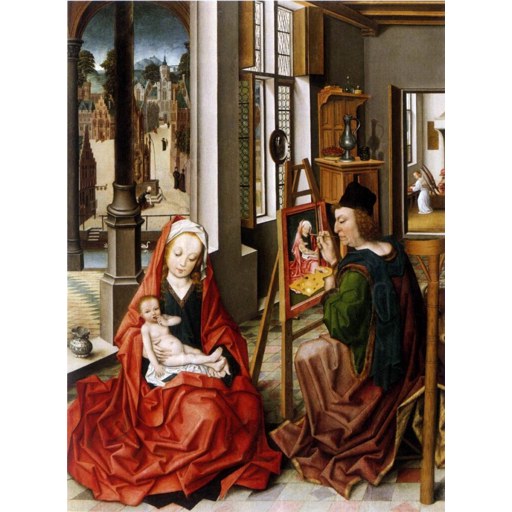
https://www.dailyartmagazine.com/saint-luke-the-ultimate-holy-painter/
License: unknown
Virgin Milburga
Saint- Life Span
- d. 715
- Feast Day
- 23 February
- Gender
- female
- Church
- Catholic
Places
Roles & Family
Religious Information
Patronage
Much Wenlock
Biography
Saint Milburga (also known as Mildburh, Mildburg, or Milburgh) was an Anglo-Saxon princess and abbess of the late seventh and early eighth centuries. She was a daughter of Merewalh, king of the Magonsaete, a Mercian sub-kingdom in the western marches corresponding roughly to later Herefordshire and southern Shropshire, and of Saint Ermenburga (also called Domne Eafe or Æbbe), a Kentish princess who founded the monastery of Minster-in-Thanet. Through her mother she belonged to the Kentish royal kindred. Her sisters were Saint Mildred (Mildrith), abbess of Minster-in-Thanet, and Saint Mildgyth; medieval devotion often grouped the three as a family of royal holy women. No contemporary source records the year or exact place of her birth.
In the later seventh century Merewalh endowed a monastic house at Wenlock (the settlement later known as Much Wenlock in Shropshire), and Milburga became its abbess. The foundation was a double monastery of women and men, a form widespread in early Anglo-Saxon England. Later tradition classed the community as Benedictine, though the precise rule observed in the original seventh-century house is not fully documented in surviving contemporary records. Milburga was remembered as foundress, abbess, and a woman of prayer and charity who used royal endowment to establish religious life on the Welsh border of Mercia. The principal narrative of her life was written centuries after her death by the Flemish monk Goscelin of Saint-Bertin in the late eleventh century, drawing on local tradition at Wenlock.
Hagiographical accounts attribute to her miracles of healing, including restoration of sight and relief of leprosy and other diseases. One widely repeated legend states that a neighbouring prince sought to marry her against her will and pursued her; a spring is said to have burst forth, or a river to have risen, so that she escaped and kept her vow of virginity. Another story relates that wild geese ravaged her fields; at her command they left and did not return, a tale later linked with the protection of crops. These stories belong to the medieval vitae rather than to seventh-century documentation, but they shaped her cult. The sources present her throughout as a consecrated virgin who refused secular marriage; there is no evidence that she had a spouse or children.
According to long-standing tradition she died at her monastery on 23 February 715 (some older authorities give 722) and was buried at Wenlock. Her cult remained largely local for some centuries. After the Norman Conquest the old minster was refounded as a Cluniac priory around 1079–1080 by Roger de Montgomery. In 1101, during building work, her tomb was discovered; the relics were translated amid reports of a fragrant odour and further miracles, which greatly increased her fame. She became the principal saint of Wenlock and of the surrounding district of Shropshire. Her feast is kept on 23 February. She was never the subject of a formal papal canonization of the later medieval type; her sanctity belongs to the era of popular and episcopal recognition later termed pre-congregation. Little beyond this outline can be verified from sources close to her own lifetime: she remains known as a Mercian royal woman who founded and ruled a monastery on the western edge of Mercia, and whose memory was preserved and elaborated by the community that claimed her as foundress.