Virgin Pelagia is a saint of the Catholic Church. Virgin Pelagia's feast day is celebrated on October 8.
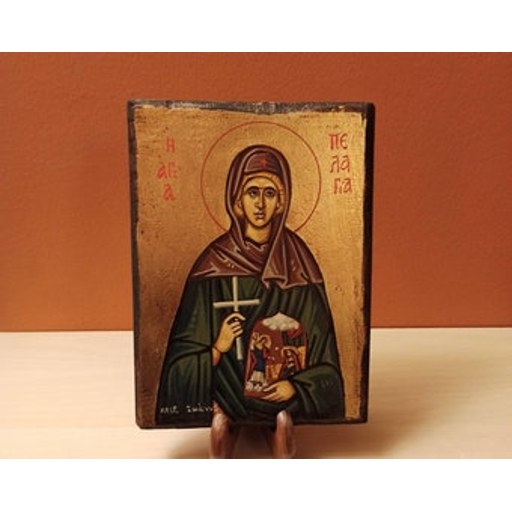
https://etsy.com/listing/1342558287/hand-painted-saint-pelagia-the-penitent
License: unknown
Virgin Pelagia
Saint- Feast Day
- October 8
- Gender
- female
- Church
- Catholic
Places
Roles & Family
Biography
Virgin Pelagia, also called Pelagia of Antioch or Pelagia the Virgin, is an early Christian martyr known almost entirely from the testimony of two Church Fathers rather than from any contemporary official record. Saint John Chrysostom delivered a homily in her honor at Antioch, treating her as a local figure already venerated there, and Saint Ambrose of Milan mentioned her in his treatise On Virgins. Both writers place her in Antioch in Roman Syria during the last great persecution of Christians in the empire, the period associated with Diocletian and his immediate successors in the early fourth century. No source records her parentage, the year of her birth, or any event of her childhood. Later martyrologies conventionally assign her death to about 311 and describe her as some fifteen years old, but those figures are inferences from the persecution’s chronology and from the homiletic portrait of a young girl; they are not independently documented.
The story preserved by Chrysostom and Ambrose is brief. Soldiers came to her house, either to arrest her as a Christian or with the intent of subjecting her to sexual violence. She asked permission to withdraw, went up to the roof, and threw herself down, dying from the fall. The Fathers present the act not as ordinary suicide but as a last means of keeping her baptismal faith and her virginity intact, a theme that recurs in late antique literature about young female martyrs. No trial transcript, imperial rescript, or eyewitness deposition survives. The narrative belongs to panegyric and moral exhortation. It was nonetheless received in the church of Antioch and in the West as the authentic memory of a local virgin martyr, and it entered the Roman Martyrology under 8 October, where she is commemorated as a virgin of Antioch.
She must be distinguished from several other saints of the same name, whose legends later overlapped in synaxaria and popular devotion. Pelagia the Penitent, sometimes also styled of Antioch, was a former actress who converted and lived as a hermit, at times under the male name Pelagius. Pelagia of Tarsus was another virgin martyr of the Diocletianic age, commemorated on a different day. Conflation of these figures produced competing or duplicated feast days in East and West. Virgin Pelagia of Antioch herself was never the object of a formal papal canonization of the later medieval type; her cult is of the ancient, pre-congregational kind, resting on local veneration and patristic witness. She is not recorded as a member of any religious order, as having married, or as having had children.
Beyond the homilies of Chrysostom and Ambrose, almost nothing else can be verified. Her place of burial is unknown. No securely attested miracles, translations of relics, or specific patronages are attached to her name in the principal liturgical and hagiographical collections. Her historical footprint is therefore small: a young Christian of Antioch in the early fourth century, remembered by two major Fathers as having chosen death rather than the violation of her faith and chastity, and kept in the calendar of the Roman church on 8 October.