Vitalian is a saint of the Catholic Church (d. 672). Vitalian's feast day is celebrated on 27 January.
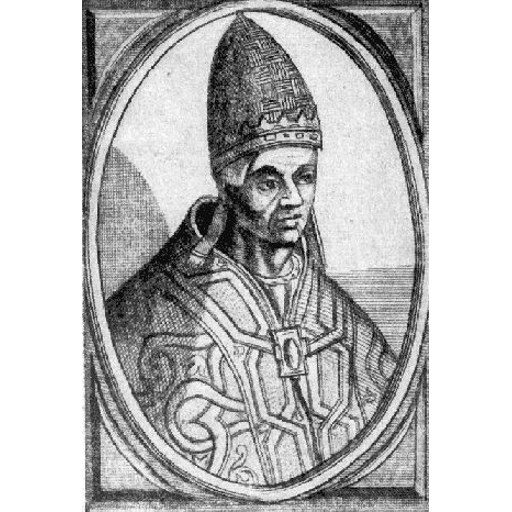
Unknown authorUnknown author
License: Public domain
Vitalian
Saint- Life Span
- d. 672
- Feast Day
- 27 January
- Gender
- male
- Church
- Catholic
Places
Relics & Where to Venerate
Location unknown
The bodily remains of Vitalian are a first-class relic. Venerated at St. Peter's Basilica.
Roles & Family
Biography
Pope Vitalian was a native of Segni in Latium, in the Roman Campagna, the son of a man named Anastasius according to the Liber Pontificalis. No contemporary source records the year of his birth. He belonged to the clergy of the Roman Church and, after the death of Pope Eugene I, was elected bishop of Rome and consecrated on 30 July 657. His pontificate lasted until 27 January 672. The political and doctrinal setting of his reign was still dominated by the aftermath of the Monothelite controversy, the humiliation and death in exile of Pope Martin I, and the uneasy dependence of the Roman see on the Byzantine imperial government.
Vitalian pursued a more conciliatory course toward Constantinople than some of his immediate predecessors. He announced his election to Emperor Constans II in terms that avoided an open breach over imperial religious policy. In 663 Constans visited Rome, the first reigning emperor to do so in many generations. Vitalian and the Roman clergy met him on the road and escorted him into the city; the emperor attended liturgy at St. Peter's and was received with high ceremonial honor. The same visit, however, was marked by Constans's removal of bronze and other valuables from Roman buildings, including the Pantheon, for shipment to the East. Constans then withdrew to Sicily, where he was assassinated in 668. Under his successor Constantine IV, relations between Rome and the imperial court gradually eased, helping to prepare the ground for the later condemnation of Monothelitism at the Sixth Ecumenical Council, which met after Vitalian's death.
Vitalian's most consequential act in the Latin West was his provision for the Church in England. After Archbishop Deusdedit of Canterbury died, the see remained vacant; a priest named Wighard was sent to Rome for consecration but died there of plague. Vitalian then chose Theodore of Tarsus, a learned Greek then living in Rome, as archbishop, and sent with him the African abbot Hadrian to ensure that Theodore would not introduce Greek usages contrary to Roman practice. Theodore was consecrated by Vitalian on 26 March 668 and reached England in 669. His subsequent organization of dioceses, synods, and schools is generally treated as a formative moment in the medieval English Church.
In Italy, Vitalian confronted the claim of Maurus, archbishop of Ravenna, to autocephaly and independence from Roman jurisdiction, a claim encouraged by imperial privilege. Vitalian resisted the pretension; the dispute continued under Maurus's successor and was only later reversed. Vitalian died in Rome on 27 January 672 and was buried in St. Peter's Basilica. He is commemorated as a saint in the Catholic Church on 27 January. Later tradition sometimes credited him with encouraging the use of the organ in Western liturgy, but that attribution is not securely documented in seventh-century sources.