Vitus is a saint of the Catholic Church (d. 303). Vitus's feast day is celebrated on 15 June. Vitus is the patron saint of actors;comedians;dancers;epileptics;against epilepsy;against chorea (Saint Vitus's dance);against oversleeping;against storms;against lightning;against animal attacks;against snake bites;young people;dogs;Bohemia;Prague;Czech Republic;Sicily;Rijeka;Mazara del Vallo.
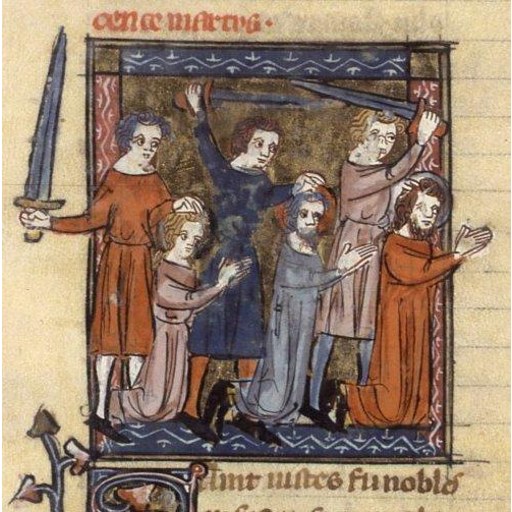
Richard de Montbaston
License: Public domain
Vitus
Saint- Life Span
- d. 303
- Feast Day
- 15 June
- Gender
- male
- Church
- Catholic
Places


Relics & Where to Venerate
Location unknown
The bodily remains of Vitus are a first-class relic. Venerated at St. Vitus Cathedral.
Roles & Family
Patronage
actors;comedians;dancers;epileptics;against epilepsy;against chorea (Saint Vitus's dance);against oversleeping;against storms;against lightning;against animal attacks;against snake bites;young people;dogs;Bohemia;Prague;Czech Republic;Sicily;Rijeka;Mazara del Vallo
Canonization
Biography
Saint Vitus, known in Latin as Sanctus Vitus, is a Christian martyr whose veneration is among the oldest and most widely diffused in the Latin Church, even though almost nothing about his life can be established from contemporary records. The principal narrative source is a Latin passio, preserved in versions that took shape in the sixth or seventh century and that historians regard as largely legendary. In that account Vitus was a child of Sicily, the son of a pagan senator named Hylas, and was converted to Christianity by his nurse Crescentia and her husband Modestus, who is also described as the boy's tutor. When Vitus refused to take part in pagan sacrifice, his father tried to force him to recant, first by persuasion and then by torture. Modestus and Crescentia thereupon fled with him. Later tradition sometimes names Mazara in western Sicily as his birthplace, but that localization is medieval and cannot be verified independently. All that can be said with caution is that the earliest layers of the cult point to Sicily and to Lucania in southern Italy, within the Roman world of the late third and early fourth centuries. The sources describe him as a boy of about seven or twelve at the time of his death; no historically attested year of birth survives, and ages given in the passio should not be treated as documentary.
The same passio places Vitus's martyrdom in the persecution associated with the emperors Diocletian and Maximian, the conventional date being about 303. According to the legend he was brought to Rome, where he is said to have delivered the emperor's son from a demon. Diocletian then ordered him to sacrifice to the gods; when he refused, he was exposed to wild beasts, cast into a cauldron of molten lead or boiling oil, and finally stretched on the rack. Iconography later made the cauldron his most recognizable attribute. Modestus and Crescentia were martyred with him. Some recensions locate the death in Rome and the burial in Lucania; others place both martyrdom and burial in Lucania. Because the acts are late, stylized, and full of conventional miracle topoi, modern scholarship does not treat the Roman trial, the child-martyr age, or the precise circumstances as historically demonstrated. What is firmer is the antiquity of the cult itself. The name of Vitus appears in early martyrologies, including the Hieronymian tradition, on 15 June, and churches and monasteries dedicated to him are attested in Italy in the early Middle Ages. He was never canonized by a formal papal process of the later medieval type; his sainthood rests on this ancient public veneration, commonly termed pre-congregation.
The medieval expansion of the cult followed the movement of relics. Relics attributed to Vitus were reported at the abbey of Saint-Denis near Paris in the eighth century. In 836 Abbot Warin of the Benedictine abbey of Corvey, on the Weser in what is now North Rhine-Westphalia, obtained relics of the saint; Corvey became the chief northern center of his honor and a point of diffusion throughout the Carolingian and Ottonian realms. From Corvey the cult entered Bohemia. In the tenth century Duke Wenceslaus acquired a relic, traditionally an arm, for the rotunda he founded on the Hradčany in Prague, the predecessor of the present St. Vitus Cathedral. That dedication made Vitus a principal patron of Prague, of the kingdom of Bohemia, and later of the Czech lands. In the fourteenth century the Emperor Charles IV rebuilt the cathedral on a grand Gothic scale, and it remains the most conspicuous monument of the saint's cult. Dedications and relic claims also took root in Sicily, in Dalmatia—where Vitus is patron of the city of Rijeka—and in many German and Italian towns.
In the later Middle Ages Vitus was numbered among the Fourteen Holy Helpers, saints invoked especially in time of plague and sudden death. He became the patron of those afflicted with chorea and epilepsy, the condition popularly known as Saint Vitus's dance (Sydenham's chorea), and by extension of dancers, actors, and comedians. He was also invoked against storms, lightning, attacks by animals and snakes, and oversleeping, and he was regarded as a protector of the young. His feast, shared in the older Roman Martyrology with Modestus and Crescentia, falls on 15 June. In the calendar reform of 1969 the companions Modestus and Crescentia were omitted from the General Roman Calendar as historically doubtful, and Vitus himself was not retained as a universal obligatory memorial, though he continues to be listed in the Roman Martyrology on that date and is kept in numerous local calendars, notably in Prague and in parts of Germany, Italy, Croatia, and Sicily. The combination of a very early Italian cult, a spectacular relic history in the north, and a distinctive set of popular patronages explains why a figure whose biography cannot be reconstructed in detail became one of the most familiar saints of medieval and baroque Europe.