Vsevolod of Pskov is a saint of the Catholic Church (d. 1138). Vsevolod of Pskov's feast day is celebrated on 11 February (repose); 22 April (translation of relics). Vsevolod of Pskov is the patron saint of Pskov.
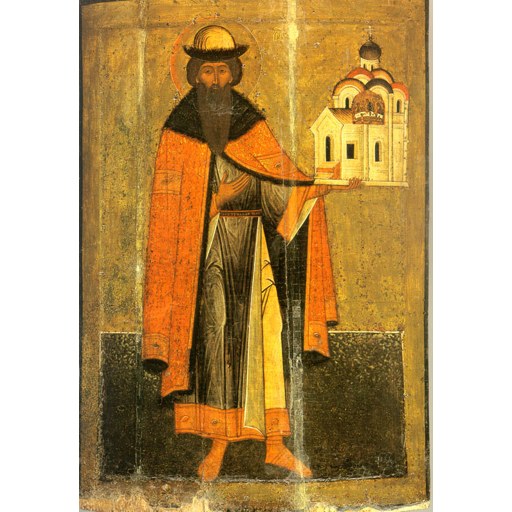
AnonymousUnknown author
License: Public domain
Vsevolod of Pskov
Saint- Life Span
- d. 1138
- Feast Day
- 11 February (repose); 22 April (translation of relics)
- Gender
- male
- Church
- Catholic
Places
Relics & Where to Venerate
Location unknown
The bodily remains of Vsevolod of Pskov are a first-class relic. Venerated at Trinity Cathedral in Pskov.
Roles & Family
Patronage
Pskov
Canonization
Biography
Vsevolod Mstislavich, venerated in the Eastern Orthodox Church as Saint Vsevolod of Pskov and also called Vsevolod-Gabriel after his baptismal name Gabriel (Gavriil), was a twelfth-century Rurikid prince. He was the eldest son of Mstislav Vladimirovich, later Grand Prince of Kiev and known as Mstislav the Great, and of Christina, daughter of King Inge the Elder of Sweden. He was raised in Novgorod, where his father ruled for many years, in the Orthodox Christian culture of the princely houses of Rus'. Contemporary chronicles do not record a precise year of birth; later reconstructions vary and cannot be treated as certain. In 1117, when Mstislav was drawn south toward the Kievan succession, Vsevolod was installed as prince of Novgorod, beginning a long and troubled association with that city and its veche.
As prince of Novgorod he appears in the local chronicles as a church-builder and as a ruler who tried to exercise princely authority in a community already protective of its customs. He is credited with founding the stone church of St. John on Opoki (begun in the later 1120s) and with other churches connected with Novgorod's market district, including a church of St. George. In 1123 the Novgorod chronicle notes his marriage; his wife's name is not given in the early sources, though later genealogists have identified her as a daughter of Sviatoslav Davydovich of Chernigov. A son, Ivan, died in childhood in 1128. After Mstislav's death, Yaropolk of Kiev in 1132 assigned Vsevolod to Pereyaslavl, a town widely regarded as a stepping-stone to Kiev. The move offended both local elites and rival branches of the dynasty. Driven from Pereyaslavl, Vsevolod returned to Novgorod, but the Novgorodians resented his having left them for a southern throne.
Those tensions ended in 1136, when the Novgorod veche seized Vsevolod, held him with his wife and children at the archbishop's compound, and expelled him. Historians often treat the episode as a landmark in Novgorod's evolution toward a more autonomous, veche-centered order. Released, he took refuge with kinsmen in the south and was given Vyshgorod. In the following year the people of Pskov, then still closely tied to Novgorod but seeking their own prince, invited him to rule. He thus became the first prince to sit independently in Pskov. Novgorod forces later moved against Pskov but did not unseat him. His tenure was brief. He died in Pskov in 1138, on 11 February according to the liturgical and chronicle tradition, and was buried in the city's church of the Great Martyr Demetrius.
Later Pskov tradition holds that his relics were found incorrupt toward the end of the twelfth century and translated to the Trinity Cathedral, which became the center of his cult. He was remembered as Vsevolod the Giver for almsgiving and as a pious defender of the city. Local veneration of Vsevolod-Gabriel took root in Pskov in the medieval period and was received into the wider calendar of the Russian Orthodox Church. He is commemorated on 11 February, the day of his repose, and on 22 April in memory of the translation of his relics, and he is honored as a heavenly patron of Pskov. A sword later shown at Pskov and sometimes linked with the later prince-saint Dovmont entered local legend as an attribute of Vsevolod. Historical knowledge of his inner life is limited to what the Novgorod and Pskov chronicles and subsequent hagiographic lives relate; those sources portray a prince whose political misfortunes in Novgorod contrasted with a reputation for church patronage and personal piety that secured his place among the holy princes of Rus'.