Wasnon de Condé is a saint of the Catholic Church. Wasnon de Condé's feast day is celebrated on 1 October. Wasnon de Condé is the patron saint of Condé-sur-l'Escaut.
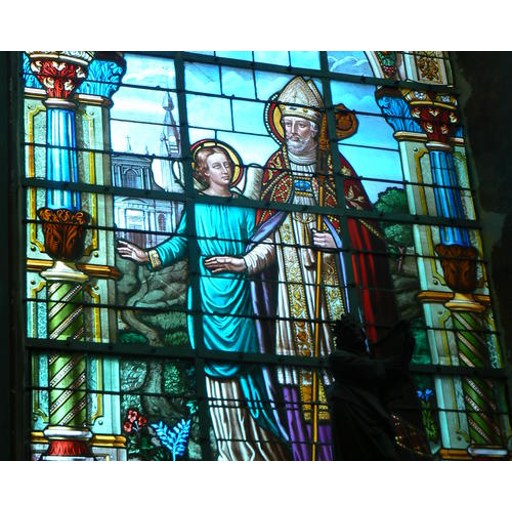
https://st-francois-escaut.cathocambrai.com/conde-sur-lescaut-eglise
License: unknown
Wasnon de Condé
Saint- Feast Day
- 1 October
- Gender
- male
- Church
- Catholic
Places
Roles & Family
Patronage
Condé-sur-l'Escaut
Biography
Wasnon of Condé, also known as Wasnulf or Wasnulphe (Latin Wasnulfus), is a Christian saint of the seventh century whose cult is centered on Condé-sur-l'Escaut in historical Hainaut, now in the Nord department of northern France near the Belgian border. Later medieval and early modern tradition describes him as a native of Scotland who left his homeland to preach on the Continent, in the wider setting of Irish and Scottish missionary activity in northern Gaul. No contemporary charter, letter, or chronicle names him, so origin, training, and career rest on hagiographical tradition rather than datable records. The Germanic form of the name Wasnulfus has led some historians to treat the Scottish story with caution, though it remains the account transmitted by his local cult. In early medieval Latin, Scotus could also mean an Irishman, which adds a further uncertainty that cannot be resolved from the surviving notices.
According to that tradition he settled at Condé, at the confluence of the Scheldt (Escaut) and the Haine, in a district that in the seventh century still mixed recent conversion with older pagan practice. Hainaut in this period saw several monastic and missionary foundations associated with figures such as Saint Ghislain, Saint Vincent Madelgarius, Saint Waltrude, and Saint Aldegund. Wasnon is remembered as a monk and preacher who lived among the people of Condé and worked for their conversion and pastoral care. Whether he ruled a community, lived as a hermit, or served as a local missionary priest cannot be established. Later writers sometimes styled him a Benedictine, an identification that is anachronistic for a seventh-century Scot or Irishman and is better read as a medieval attempt to place him within a familiar monastic framework. There is no tradition of marriage or of children; he is remembered only as a celibate monastic missionary.
He is said to have died at Condé. Later tradition sometimes assigns the death to the year 651, on or about the date that became his feast, but that year is not confirmed by any independent seventh-century source and should be treated as conventional rather than verified. He was buried locally. A church dedicated to him, the collegiate church of Saint-Wasnon at Condé-sur-l'Escaut, became the focus of his veneration; the present Gothic building, reconstructed in later centuries, preserves his name and the memory of a collegiate chapter that long served the town. Relics associated with him were kept and honored there. His feast is observed on 1 October. He was never the subject of a formal papal canonization of the later medieval type; his status as a saint rests on ancient local cult, as is typical of many holy men of the Merovingian period.
Wasnon remains the patron saint of Condé-sur-l'Escaut. Beyond that civic patronage, no wider list of patronages is securely attached to him in the major martyrologies. He held neither the papacy nor any patriarchal see. The historical Wasnon is therefore an obscure figure whose biography cannot be reconstructed in detail, but whose cult illustrates the seventh-century Christianization of Hainaut and the way a local holy man could become the enduring titular saint of a frontier town on the Scheldt.