Wenceslaus is a saint of the Catholic Church. Wenceslaus's feast day is celebrated on 28 September. Wenceslaus is the patron saint of Bohemia;Czech Republic;Prague;Czech people;Moravia;brewers.
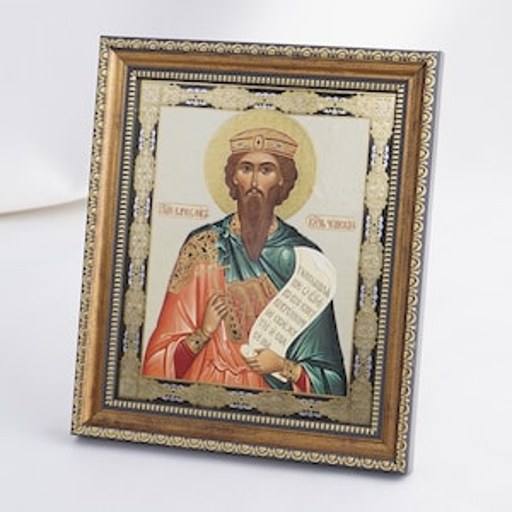
https://www.etsy.com/market/saint_wenceslaus
License: unknown
Wenceslaus
Saint- Feast Day
- 28 September
- Gender
- male
- Church
- Catholic
Places
Roles & Family
Patronage
Bohemia;Czech Republic;Prague;Czech people;Moravia;brewers
Biography
Saint Wenceslaus (Czech: Václav), duke of Bohemia in the tenth century, belonged to the Přemyslid dynasty and is venerated as a martyr and as the chief patron saint of the Czech lands. He was the son of Duke Vratislaus I and of Drahomíra, a princess from the Slavic Hevelli on the Elbe. His grandmother Saint Ludmila, wife of the first historically attested Přemyslid duke Bořivoj I, had received Christianity in connection with the Cyrillo-Methodian mission and became the decisive influence on the boy’s upbringing. After Vratislaus died in the early 920s, Ludmila took Wenceslaus into her care and had him instructed in the Christian faith and in letters, in both the Slavonic and Latin traditions then present in Bohemia. A bitter conflict followed between Ludmila’s Christian court party and Drahomíra. Ludmila was murdered at Tetín, an event that the later legends treat as martyrdom and that left Wenceslaus as the representative of a more firmly Christian ducal policy.
Wenceslaus took personal control of the duchy in the mid-920s, after a regency. He is credited with founding or completing important churches, above all a rotunda of Saint Vitus at Prague Castle, which later grew into the cathedral that still houses his tomb. In foreign affairs he accepted the overlordship of the East Frankish or Saxon king Henry I (Henry the Fowler), paying tribute after a German intervention in Bohemia. That settlement kept the duchy within the orbit of the Ottonian world but was resented by nobles who preferred a more independent or still partly pagan course. Near-contemporary Slavonic and Latin legends—among them the First Old Church Slavonic Life, the Latin Crescente fide, and the legend commissioned from Bishop Gumpold of Mantua in the Ottonian circle—depict Wenceslaus as a ruler of unusual personal piety: attending the liturgy, copying books, protecting clergy, and showing charity to the poor, guests, and prisoners. These texts are works of hagiography, not archives, yet they preserve the outline of a Christian prince whose manner of government and whose alignment with the Saxon court divided his own family.
Opposition gathered around his younger brother Boleslaus. On 28 September, in a year that medieval writers and modern scholars have given variously as 929 or 935, Wenceslaus went to Boleslaus’s fortress of Stará Boleslav for the feast of Saints Cosmas and Damian. He was struck down there by Boleslaus and several accomplices. The killing was at once read as martyrdom. Boleslaus succeeded to the ducal throne; within a few years the body of Wenceslaus was translated from Stará Boleslav to the church of Saint Vitus in Prague, which became the centre of his cult. No pope of the later, centralized type canonized him; his sainthood belongs to the older pattern of local episcopal and popular veneration, soon received in the Empire and throughout the Latin Church. The feast on 28 September was established as his principal day and is now also observed in the Czech Republic as Czech Statehood Day.
In later medieval Bohemia Wenceslaus was treated as the perpetual sovereign of the land: dukes and kings ruled as his heirs, and the crown used at Bohemian coronations was called the Crown of Saint Wenceslas. His chapel in Saint Vitus Cathedral, the statue in the upper part of Wenceslas Square in Prague, and countless dedications of churches and towns carried the cult through the Hussite, Habsburg, and modern periods. The nineteenth-century English carol Good King Wenceslas, though historically free in its details, made his name familiar in the English-speaking world as a type of Christian charity. He is invoked as patron of Bohemia, of the Czech Republic and the Czech people, of the city of Prague, and, in some lists, of Moravia and of brewers. His relics remain in Saint Vitus Cathedral at Prague Castle.