Wera of Utrecht is a saint of the Catholic Church. Wera of Utrecht's feast day is celebrated on 8 May. Wera of Utrecht is the patron saint of Diocese of Roermond;Sint Odiliënberg.
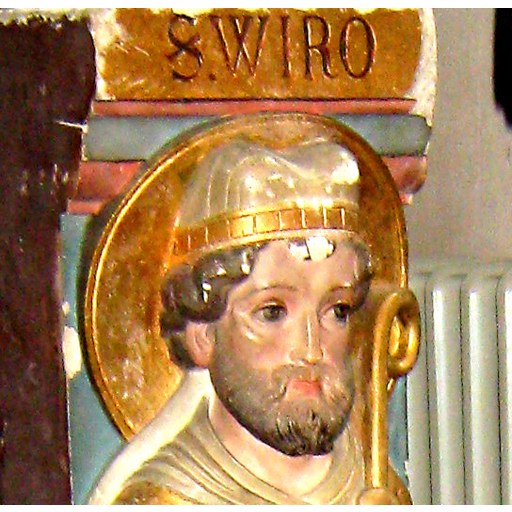
St_Odiliënberg_3_Doppelstatuen.jpg: Norbert Schnitzler derivative work: Velopilger (talk)
License: CC BY-SA 3.0
Wera of Utrecht
Saint- Feast Day
- 8 May
- Gender
- male
- Church
- Catholic
Places
Roles & Family
Patronage
Diocese of Roermond;Sint Odiliënberg
Biography
Saint Wiro (also known as Wera, Wiro of Roermond, or Wiro of Utrecht) was an eighth-century missionary bishop venerated in the Meuse–Roer region of what is now the southeastern Netherlands. He is almost always commemorated together with two companions, Saints Plechelm (Plechelmus) and Otger (Otgerus or Odger). The main narrative of his career is a Latin vita written long after the events it recounts, probably in the tenth or eleventh century, and it cannot be read as a contemporary biography. Later liturgical use at Sint Odiliënberg, Roermond, and Utrecht expanded the same traditional outline. No reliable source records a year of birth, and later dates sometimes given for his death (including around 710 and around 753) are not confirmed by early evidence.
According to the vita, Wiro was of noble birth and came from Northumbria in Britain; some recensions and later retellings instead associate him with Ireland or Scotia. He is said to have been ordained priest, to have gone on pilgrimage to Rome, and to have received episcopal consecration there before returning as a missionary. Modern historians generally place his work in the wider Anglo-Saxon mission to Frisia and the lower Rhine, the movement linked with Willibrord in the late seventh and early eighth centuries and carried on under Frankish protection. Assertions that Wiro himself held the see of Utrecht are not supported by early episcopal lists and are usually treated as later attributions. His historical association is with the Roer valley rather than with the city of Utrecht, despite the secondary epithet “of Utrecht.”
Tradition holds that a Frankish ruler, often identified as Pepin of Herstal, granted Wiro a site at Berg—later Sint Odiliënberg—on a hill above the river Roer near present-day Roermond. There Wiro, Plechelm, and Otger are said to have founded a church and monastic community, dedicated in some accounts to Saints Peter and Paul. The house served as a base for preaching and pastoral care among a population that was still only partly Christian in Austrasia. That community became the centre of Wiro’s cult. A collegiate church on the site, now the Basilica of Saints Wiro, Plechelm and Otger, remains the principal shrine.
Wiro is believed to have died at Odiliënberg in the eighth century. His feast is kept on 8 May, sometimes jointly with Plechelm and Otger; in the Diocese of Roermond the three have also been observed on 11 May. Relics attributed to them were kept at Sint Odiliënberg, taken for a time to Utrecht in the tenth century during a period of raids, and later returned. Wiro is honoured as a patron of the Diocese of Roermond and of Sint Odiliënberg. He was not Bishop of Rome and did not hold a patriarchal see. The sources present him throughout as a missionary bishop and monastic founder; nothing indicates a spouse or children.