Werenfried is a saint of the Catholic Church (d. 760). Werenfried's feast day is celebrated on 14 August. Werenfried is the patron saint of Elst;vegetable gardeners;sufferers from gout.
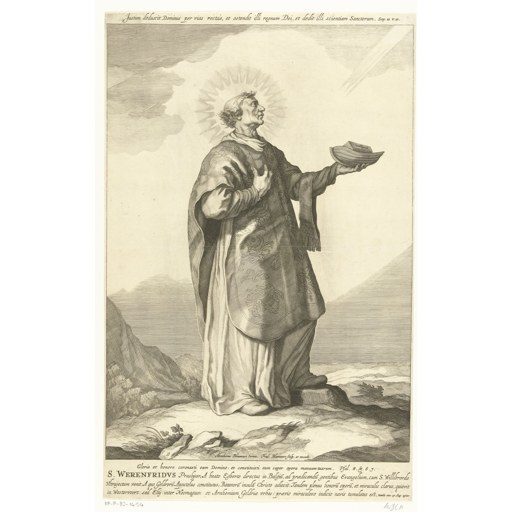
Rijksmuseum
License: CC0
Werenfried
Saint- Life Span
- d. 760
- Feast Day
- 14 August
- Gender
- male
- Church
- Catholic
Places
Roles & Family
Religious Information
Patronage
Elst;vegetable gardeners;sufferers from gout
Canonization
Biography
Werenfried of Elst (also called Werenfridus, Werenfrid, or Werenfried of Westervoort) was an Anglo-Saxon monk and missionary priest of the eighth century, honoured as a saint especially in the Dutch river country of Gelderland. Contemporary written evidence for his life is lacking; what is known comes from later medieval tradition, liturgical commemoration, and the archaeology and history of the church at Elst. He is said to have been born in England and to have embraced the monastic life according to the Rule of Saint Benedict before joining the mission to the Frisian and Frankish lands. That mission was led by Saint Willibrord, who had been consecrated archbishop of the Frisians in 695 and who established his see at Utrecht. Werenfried is numbered among Willibrord’s companions or among the English clergy who continued that work in the following generation. The political setting was the expansion of Frankish Christian authority into the Low Countries under the early Carolingians, a process that mixed preaching, the foundation of churches, and the suppression of remaining pagan cults.
The district with which Werenfried’s name is inseparably linked is the Over-Betuwe, the island-like territory between the Rhine and the Waal in what is now the province of Gelderland. Elst, already a place of some importance in Roman times, possessed a stone church erected on the podium of a former Gallo-Roman temple; excavations in the twentieth century confirmed that a Christian church stood there from the early medieval period. Tradition presents Werenfried as the priest who served this church and the surrounding hamlets, living in monastic simplicity while instructing recent converts and administering the sacraments. No charter or letter names him in an eighth-century context, so the details of his pastoral methods remain unknown. His reputation for holiness, however, was strong enough that a cult formed around his tomb within a few generations of his death, which is the principal reason his memory survived at all.
The account of his death, preserved in later legend, places it at Westervoort, a settlement a short distance from Arnhem near the Rhine, about the year 760. Both Westervoort and Elst claimed the right to bury him. The body was therefore laid in a boat and committed to the river; the unmanned vessel is said to have moved against the current until it came ashore at Elst. The episode, whether or not it has any historical kernel, belongs to a widespread hagiographical type used to justify the location of a saint’s shrine. Werenfried was buried in the church of Elst, which thereafter bore his name. In subsequent centuries the church was rebuilt more than once; the present Great Church (Grote Kerk) of Elst stands on the same site and long housed his relics. Portions of the relics were later distributed. In 1664, during the post-Reformation period when public Catholic worship in the Dutch Republic was restricted, some relics were taken to the Benedictine abbey of Ochsenhausen in present-day Baden-Württemberg.
Werenfried was never the subject of a papal canonization process; his cult is pre-Congregation, resting on local veneration and insertion into regional calendars and martyrologies. His feast day is 14 August. He is the patron saint of Elst and has customarily been invoked by vegetable gardeners and by people afflicted with gout. Devotion to him remained largely confined to the Betuwe and to those churches that obtained relics. Modern historical judgement treats him as a genuine eighth-century English missionary whose biography was filled out by legend, and whose enduring significance lies in the continuity of Christian worship at Elst from the age of Willibrord to the present.