Widukind is a blessed of the Catholic Church.
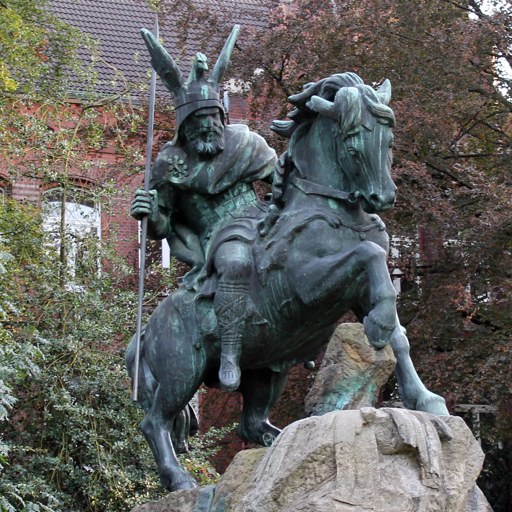
Drahreg01
License: CC BY-SA 3.0
Widukind
Blessed- Gender
- male
- Church
- Catholic
Places
Relics & Where to Venerate
Location unknown
The bodily remains of Widukind are a first-class relic. Venerated at Stiftskirche Enger.
Roles & Family
Biography
Widukind (also known as Wittekind) was a Saxon noble and war leader of the late eighth century, remembered as the foremost opponent of Charlemagne during the Saxon Wars. He belonged to the Westphalian Saxons, one of the major groupings of the still-pagan continental Saxons who inhabited the lands between the Rhine and the Elbe. Almost nothing can be established about his birth, family, or early career from contemporary evidence. He enters the historical record in Frankish sources, principally the Royal Frankish Annals, which portray him as the instigator of Saxon resistance when many other nobles were prepared to submit to Frankish overlordship and to accept Christian baptism.
In 777 Charlemagne held a great assembly at Paderborn, at which numerous Saxon leaders appeared, gave hostages, and were baptized. Widukind did not attend; the annals state that he had withdrawn to the protection of the Danish king Sigfred. The next year, while Charlemagne was occupied with the Spanish campaign that ended at Roncesvalles, Widukind returned and raised a large-scale revolt, destroying Frankish garrisons and carrying raids westward. Renewed insurrections followed in subsequent years. The war was marked by extreme severity on both sides. In 782, after a Frankish force was defeated near the Süntel mountains, Charlemagne is reported to have had some 4,500 Saxon prisoners beheaded at Verden. Widukind was not among the dead; he had again taken refuge in Danish territory. Fighting continued until 785. That year Charlemagne wintered in Saxony, laid the country waste, and finally induced Widukind to come in. The Saxon leader travelled to the royal palace at Attigny in Francia, where he was baptized, with Charlemagne standing as his godfather. Frankish annalists present the baptism as the turning point that ended the main phase of Saxon resistance under his leadership.
After 785 Widukind disappears from strictly contemporary narrative sources. No eighth-century text records the date or place of his death, the name of a wife, or the existence of children. Later medieval writers, working in a Christian Saxon milieu that had come to regard the conversion of their ancestors as providential, filled the silence with legend. A Danish or Westfold princess named Geva was assigned to him as wife in some traditions; tenth-century lives of Queen Matilda claimed that the Ottonian house descended from him; and a death date in 807 or 808, together with burial at Enger in Westphalia, became established in local memory. A church of Saint Dionysius at Enger and a medieval tomb there were associated with him, and a local cult grew up around this shrine. In parts of Westphalia he has been venerated as a blessed convert and Christian prince, though he was never formally canonized by the papacy, and the historical basis of the Enger burial remains unproven.
Modern scholarship therefore distinguishes sharply between the Widukind of the Royal Frankish Annals—a Saxon war-leader who resisted Frankish conquest from 777 until his submission and baptism in 785—and the Widukind of later Saxon and popular tradition, who became an ancestral hero, a legendary ancestor of kings, and a focus of regional piety. The earlier figure can be described with some confidence from eighth-century Frankish records; the later figure belongs to the history of medieval memory, genealogy, and local devotion rather than to the recoverable facts of his life.