Wilhelm Eiselin is a blessed of the Catholic Church (1564 - 1588).
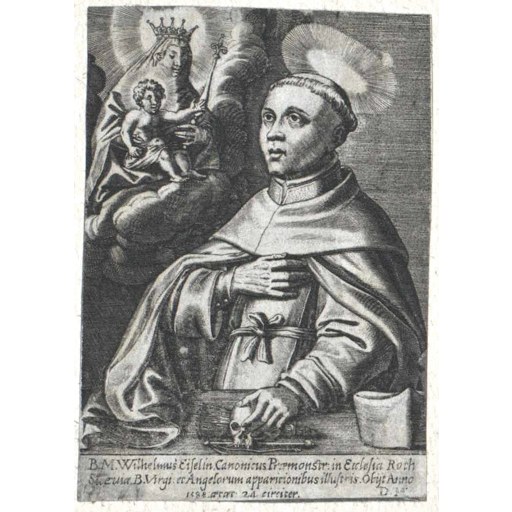
zeitgenössischer Stecher, 1650
License: Public domain
Wilhelm Eiselin
Blessed- Life Span
- 1564 - 1588 (age 24)
- Gender
- male
- Church
- Catholic
Places
Roles & Family
Religious Information
Biography
Wilhelm Eiselin was a German Premonstratensian canon of the late sixteenth century. He was born in 1564 in Rottenburg am Neckar, a Swabian town then under Habsburg rule within the Holy Roman Empire. In his youth he entered the Premonstratensian abbey of Obermarchtal (Kloster Obermarchtal), a house of canons regular in Upper Swabia. The Premonstratensians, or Canons Regular of Prémontré, founded by Norbert of Xanten in the twelfth century, combined community life under the Rule of Saint Augustine with liturgical and pastoral duties; Obermarchtal was one of their notable abbeys in the German lands.
Eiselin spent his entire brief religious life at Obermarchtal. Later local tradition and order-related accounts presented him as a model of piety, humility, and regular observance, but he held no high office in the community. He died at the abbey on 28 March 1588, at about twenty-four years of age. Because of his early death he remained a relatively obscure figure in the wider history of the order during his lifetime.
After his death a popular cult developed at Obermarchtal. Reports circulated that his body remained incorrupt, and the community treated his remains with special reverence. Pilgrims visited the abbey, and Eiselin came to be regarded locally as a saintly person, sometimes styled “blessed” in regional usage. A written life of him was produced in connection with this veneration. The cult, however, stayed essentially regional and was never confirmed by a formal beatification or canonization process of the Holy See.
Obermarchtal Abbey continued until secularization in the early nineteenth century. Eiselin’s memory survives mainly in local Swabian tradition and in Premonstratensian historical literature rather than in the universal calendar of the Catholic Church. Beyond his dates and places of birth and death, his membership in the Premonstratensian community, and the fact of posthumous local veneration, reliable biographical detail in widely accessible sources remains limited.